

The Pakistani car market is changing rapidly. Up until 2021-22, it felt that things were about to take off for the Pakistani auto consumers but the industry saw a sudden halt due to the 2022 regime change. But the import restrictions, sky-high interest rates, and a brutal economic slowdown dragged annual vehicle sales down by a staggering 69%. And now I think it is fair to say that within these three years, the buyers are spoilt for choice. From super expensive high-end luxury BEVs to ultra cheap family budget cars, between locally assembled turbo crossovers, rear-wheel-drive electric hatchbacks, and ultra-budget city EVs, there is so much on the offer for the people to choose from.
And considering today’s blog’s topic, there are vehicles sitting under the Rs 60 lac mark that we are going to look at. And if you had told someone in 2023 all this, they probably would have laughed you out of the showroom. Yet, here we are in late 2026, watching one of the most interesting turnarounds in Pakistan’s automotive history.
The numbers tell the story pretty clearly. After rebounding by 52% in 2024, passenger car sales kept climbing, hitting 155,631 units in FY26. That is a 39% year-on-year jump. That momentum has only accelerated through the second half of this year. According to industry data, year-to-date vehicle sales through October 2026 reached 188,668 units (up 28.4% over last year), with monthly car sales hitting a four-year high in October on the back of a 41% surge in small-car demand.
Lower policy rates, stabilized exchange rates, and a wave of aggressive new entrants, especially the Chinese automakers partnering with established local groups, have finally broken the old monopoly of the Big 3 and hegemony where buyers were forced to pay ridiculous amounts of money for bare-bones, decades-old cars.
Thanks to all the new Chinese automakers, you don’t just have to settle for a used sedan or a basic hatchback anymore. Now, if you have a budget of under Rs 6 million (60 lacs) in 2026, you can get yourself a pretty decent brand new car. Several brand-new models and refreshed variants have officially launched in this exact bracket this year.
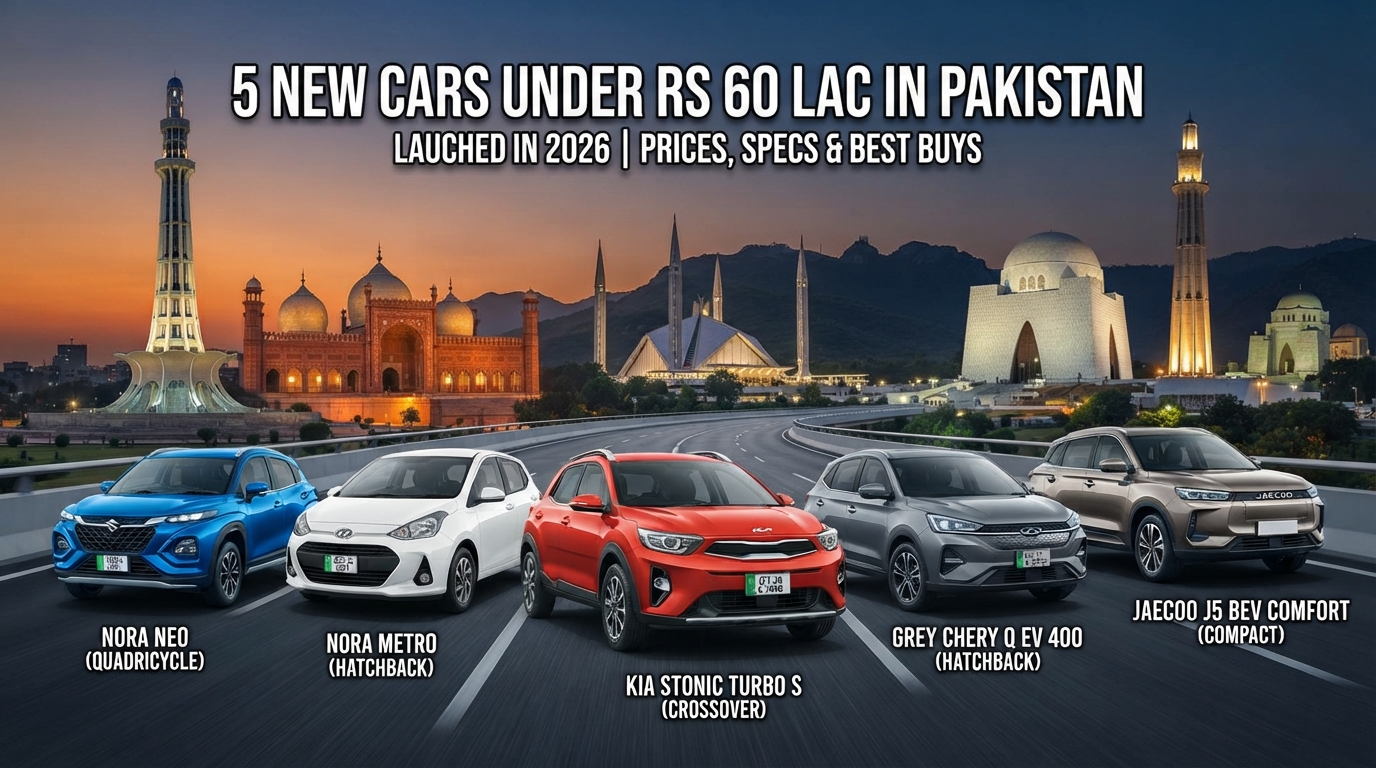
Today, we are going to look closely at the five most affordable new cars launched in Pakistan in 2026—running from the ultra-budget Nora Neo and Nora Metro all the way up to the Chery Q EV 400the new Kia Stonic Turbo, and the newly launched full electric battery vehicle Jaecoo J5.
Now let’s get into the nitty-gritty of what each of these cars brings to the table, who is behind them, what they actually offer on paper, and who their real competition is.
The Under-Rs 6M Class of 2026
The cars we will be talking about today are as follows along with their variants and prices.
| Make | Model & Variant | Ex-Factory Price (PKR) |
| Nora EV | Nora Neo — Comfort | Rs. 2,499,999 |
| Nora EV | Nora Metro — Deluxe | Rs. 2,899,999 |
| Chery | Chery Q — EV 400 | Rs. 5,554,000 |
| Kia | Stonic — 1.0L Turbo S | Rs. 5,899,000 |
| JAECOO | JAECOO J5 — BEV Comfort | Rs. 5,999,000 |
Disclaimer: ex-factory prices do not include freight, withholding tax, registration, etc.
Here is a brief look at the drivetrains and the launch dates of these vehicles.
| Model & Variant | Powertrain Type | Launch / Price Date |
| Nora Neo — Comfort | Pure Electric (23.1 kWh LFP) | Oct 20, 2026 (PAPS Sept) |
| Nora Metro — Deluxe | Pure Electric (23.1 kWh LFP) | Oct 20, 2026 (PAPS Sept) |
| Chery Q — EV 400 | Pure Electric (42.7 kWh LFP) | Sept 18, 2026 (PAPS 2026) |
| Stonic — 1.0L Turbo S | 1.0L Turbo GDI Petrol (7-DCT) | Oct 1, 2026 (PAPS Sept 18) |
| JAECOO J5 — BEV Comfort | Pure Electric (49.5 kWh) | Oct 6, 2026 (Valid till Nov 30, 2026) |
Nora Neo – Comfort (Rs. 2,499,999 ex-GST)
While big conglomerates like Lucky Motor and Master Group are fighting over the Rs 5.5 million to Rs 13 million SUV and crossover space, Nora EV is one of the local micro-mobility and entry-level electric vehicle players trying to crack the complete opposite end of Pakistan’s automotive market.
Nora is taking a very different approach by targeting motorcyclists looking to upgrade to four-wheels, daily intra-city commuters, and households looking for a second-car but simply cannot justify spending Rs 30–35 lacs on a basic 660cc petrol hatchback. The company unveiled the Nora Neo at PAPS 2026 in September following up on their earlier launch of Nora E30 city car. The price of Neo Comfort was revealed in October 2026.
Specs
First things first, let’s be completely honest about what Nora Neo is and what it isn’t. Even though it has 5 doors and can seat four adults, the Nora Neo is officially classified as an L7 quadricycle rather than a full-fledged passenger car. This needs to be addressed because L7 classification allows manufacturers to keep weight, powertrain output, and costs dramatically lower than conventional M1 passenger cars.
Here is the snapshot what Nora Neo has to offer:
| Engine / Motor Output | 4 kW (~5.3 hp) Electric Motor |
| Peak Torque | N/A (72V Low-Speed Drive) |
| Transmission / Drivetrain | Single-Speed / RWD |
| Top Speed / 0–100 km/h | 70 |
| Battery Capacity / Fuel Tank | 23.1 kWh LFP (72V) |
| Claimed Range / Mileage | 250–300 km (Claimed) |
| Charging Time / Fast Charge | 6–8 hrs (Standard Home AC) |
| Warranty Coverage | 3-Yr Replacement / 7-Yr Cells |
| Ground Clearance (mm) | 180 |
| Wheelbase (mm) | 2,300 |
| Wheel & Tyre Size | 175/70 R13 |
In terms of size, the Neo is actually 125 mm wider and 110 mm taller than a Suzuki Alto, though 95 mm shorter in overall length. The car has a 2,300 mm wheelbase with a surprisingly generous 180 mm of ground clearance and 175/70 R13 tyres. That 180 mm road clearance is a huge plus on broken and dug up roads and massive speed breakers where regular small hatchbacks scrape their bellies.
Underneath, the Comfort variant comes with a 23.1 kWh Lithium Iron Phosphate (LFP) battery running on a 72V system. The power is sent to a rear-mounted 4 kW electric motor (which translates to roughly 5.3 horsepower). Yeah sure the horsepower numbers aren’t actually spinecrushing but remember what this car is built for; cheap mode of transportation. Top speed is capped at 70 km/h, and Nora claims a driving range of 250 to 300 km on a full charge. The charging can take about 6 to 8 hours on a standard home socket. You also get an LFP battery which is a plus considering extreme Pakistani summer heat. LFP acts far better than older lead-acid or NMC packs in extreme conditions. The battery is also backed by a 3-year replacement guarantee and a 7-year cell warranty.
This car is not intended for you to take a cross country on. At 70 km/h with 4 kW of output you are not gonna climb Babusar Top. That is not the point of this car. The point is that it is strictly an urban commuter. As for the inside, you get basic creature comforts like air conditioning, power windows, a digital display, and reversing camera, without any pretend luxury.
Direct Price Competition
At Rs. 2.50 million (ex-GST), the Nora Neo Comfort doesn’t really have any brand-new four-wheel competitors at its price point. Once you factor in GST and registration, your real-world alternatives are:
- Used 660cc JDM Kei Cars (Suzuki Alto, Daihatsu Mira, Nissan Dayz): For Rs 26–30 lacs, you can buy a clean 2020–2022 imported Japanese 660cc automatic with proper highway capability, airbags, and high resale value, though you will be paying Rs 250+ per liter for petrol.
- Brand-New Suzuki Alto VX (Rs. 2.33M – 2.5M range): The base manual Alto gives you proven nationwide parts availability and unrestricted highway speed, minus the automatic convenience, AC (on the base VX), and ultra-cheap Rs 2–3 per kilometer electricity running costs of the Nora.
Nora Metro – Deluxe (Rs. 2,899,999 ex-GST)
The Nora Metro was launched alongside the Neo at PAPS 2026. With the launch of Metro, Nora EV is trying to bridge the gap between a proper mainstream hatchback and a quadricycle. People can be self conscious about driving a quadricycle through the city traffic specially with their family. Keeping that in mind, Nora engineered the Metro with broader, more planted proportions while keeping the exact same low-cost L7 regulatory architecture.
Specs
You will immediately notice the difference between the Metro and Neo when they are parked side by side next to a regular hatchback. Metro’s footprint is closer to a standard B-segment hatchback. The funny thing is that the metro is actually wider and taller than the Suzuki swift. The wheelbase measures at 2,360 mm and it comes with strangely enough 195/70 R14 tires. On top of that you get a ground clearance of 210 mm which is somewhere around the ground clearance of Honda BRV. And the funny thing is it is kind of higher than most of the current lot of SUVs available in the market right now.
| Engine / Motor Output | 4 kW (~5.3 hp) Electric Motor |
| Peak Torque | N/A (72V Low-Speed Drive) |
| Transmission / Drivetrain | Single-Speed / RWD |
| Top Speed / 0–100 km/h | 70 |
| Battery Capacity / Fuel Tank | 23.1 kWh LFP (72V) |
| Claimed Range / Mileage | 250–300 km (Claimed) |
| Charging Time / Fast Charge | 6–8 hrs (Standard Home AC) |
| Warranty Coverage | 3-Yr Replacement / 7-Yr Cells |
| Ground Clearance (mm) | 210 |
| Wheelbase (mm) | 2,360 |
| Wheel & Tyre Size | 195/70 R14 |
But the drivetrain is identical to what you get in the lower variant; the neo comfort. Metro has the same 23.1 KWh LFP battery and the similar 4 KW rear-wheel drive motor setup that you get in the smaller neo. Although the company says you get the same 250 to 300 claimed kilometres but considering it is a little bigger and heavier than the smaller neo, I think it is fair to say that the claimed range is highly doubtful. The battery range can shorten significantly during the summers when you have your AC turned on. You also get a slightly upgraded interior trim as well as an infotainment system.
Charging is gonna take the same 6 to 8 hours if you are doing it at your home plugged into your regular 220V wall socket.
As mentioned above, you get the same 4 KW system in this relatively bigger vehicle. So it is fair to say that you aren’t going to break any speed records with this vehicle. But you can get a modest ride within a city with decent comfort and great economy. Don’t take this car to Nathiagali, that’s what I’m trying to say. For a start and stop rush hour traffic, you are good to go.
Direct Price Competition
Once you add GST and on-road charges to the Rs. 2.90 million ex-factory tag, the Nora Metro Deluxe lands squarely around the Rs 3.3–3.4 million mark. That puts it up against:
- Suzuki Alto VXR / VXR-AGS (Rs. 2.7M – 3.1M): The undisputed king of Pakistani small cars. The Alto AGS gives you an automated manual gearbox, nationwide resale liquidity, and 120+ km/h highway capability, whereas the Metro gives you massive space, 210 mm clearance, and a fraction of the monthly fuel bill.
- Dewan Honri-VE (200 / 300): Priced higher (typically Rs. 3.9M–4.5M+), the Honri-VE is a proper M1-category electric hatchback with a 30 kW motor and 100 km/h top speed, making it noticeably faster than the Nora—though you pay roughly Rs 10 lacs more for that privilege.
Chery Q – EV 400 (Rs. 5,554,000)
Chery is one of China’s largest automotive manufacturers and exporters. Initially Chery China launched Tiggo 4 and Tiggo 8 Pro with Ghandhara Pakistan but the partnership fell apart. Ghandhara is the same company that made and sold Nissan and Isuzu vehicles in Pakistan and we all know how that ended. So it is fair to say Chery made a good call when in 2026 they switched to Master Auto Engineering (Pvt.) Limited which is a subsidiary of Master Group and makes and sells Changan and Deepal cars in Pakistan as well.
At PAPS 2026 on September 18, Chery dropped a genuine bombshell by launching the Chery Q EV 400 at an introductory ex-factory price of Rs. 5,554,000, undercutting almost every serious full-size electric hatchback in the country.
Specs
Unlike tiny city EVs, the Chery Q is a proper five-seater B-segment hatchback that measures at 4,195 mm in length and is 1,811 mm wide and has a rather unusually long wheelbase at 2,700 mm. Why is it unusual you may ask? Well it is because it is longer than a Toyota Corolla’s wheelbase. And the fact Q EV has a practical 440-liter boot space. Ground clearance sits at a respectable 166 mm on 215/60 R17 alloy wheels.
| Propulsion Type | Pure Electric (BEV) |
| Engine / Motor Output | 94 kW (126 hp) Electric Motor |
| Peak Torque | Instant EV Torque |
| Transmission / Drivetrain | Single-Speed / RWD |
| Top Speed / 0–100 km/h | 135 |
| Battery Capacity / Fuel Tank | 42.7 kWh LFP |
| Claimed Range / Mileage | 400 km (NEDC) |
| Charging Time / Fast Charge | 40 min (10–80% DC) / 8 hrs AC |
| Warranty Coverage | 8-Yr / 160,000 km Battery |
| Ground Clearance (mm) | 166 |
| Wheelbase (mm) | 2,700 |
| Wheel & Tyre Size | 215/60 R17 Alloy |
| Seating / Boot Capacity | 5-Seater / 440L Boot |
| Airbags | 6 Airbags |
| Active Stability & Braking | ABS + ESC + Auto Hold + TPMS |
| ADAS & Camera System | Full L2 ADAS (ACC, AEB, LKA, BSD) + 540° Cam |
| Infotainment & Audio | 15.6-inch Touchscreen (Wireless CarPlay/AA) |
| Sunroof | Panoramic Sunroof |
| Keyless Entry / Start | Smart Key + Push Start |
| Headlamps | Full LED |
| Seat Upholstery & Adjustment | Leather / Dual Front Electric Seats |
Under the floor sits a 42.7 kWh Lithium Iron Phosphate (LFP) battery backed by an 8-year / 160,000 km warranty. Even better, instead of a front-wheel-drive setup, Chery gave the Q a rear-wheel-drive (RWD) electric motor. The motor makes 126 horsepower and can achieve a top speed of 135 km/h. That RWD layout gives it crisp handling and a tight 5.2-meter turning radius. Chery claims a 400 km range (NEDC)—which translates to roughly 310–330 km in real-world city driving. The vehicle also supports DC fast charging and can charge from 10% to 80% in pretty remarkable 40 minutes. And if you are going to charge the Q EV with the company provided free 7 kW home charger, the car will charge in around 8-hour. The charger is being provided to early adaptors only.
Inside, the feature list reads like a Rs 1 crore luxury SUV. You get a massive 15.6-inch central infotainment display with wireless Apple CarPlay and Android Auto, a digital instrument cluster, a panoramic sunroof, leather seats with electric adjustment for both driver and front passenger, a wireless phone charger, and a 540-degree transparent-chassis camera.
As for the safety features are concerned, you get 6 airbags and a full Level-2 ADAS suite including Adaptive Cruise Control, Autonomous Emergency Braking, Lane Keep Assist, Blind Spot Detection, Rear Cross Traffic Alert, and Door Opening Warning.
The only apparent downside is that like any other EV, you get kinda slow charging and the inherent fear of running out of charge. If you regularly drive Lahore-to-Islamabad or Karachi-to-Sukkur without wanting to plan charging stops, a pure EV still requires patience. Plus, because Master Auto only just launched the Q in September 2026, long-term parts availability and resale values are still unproven.
Direct Price Competition
At Rs. 5,554,000, the Chery Q EV 400 makes several rivals look noticeably overpriced:
- MG Binguo EV Pro (Rs. 5.699M) & GuGo Box E1 Eco (~Rs. 5.70M): Both rivals cost roughly Rs 1.5 lacs more than the Chery Q while offering smaller batteries (31.9 kWh on the Binguo), front-wheel drive, shorter wheelbases, and far less ADAS tech.
- JAECOO J5 BEV Comfort (Rs. 5,999,000): Launched in November 2026, the J5 BEV Comfort gives you a larger compact SUV body and a 49.5 kWh battery for Rs 4.45 lacs more, though the base Comfort trim strips out the panoramic sunroof, powered leather seats, and huge screen that come standard on the Chery Q.
Kia Stonic – 1.0L Turbo S (Rs. 5,899,000)
Lucky Motor Corporation (LMC) needs no introduction in Pakistan. Since entering the market in 2019 with the Sportage and Picanto, LMC has arguably been the single most disruptive assembler in the country. The company forced stubborn companies like Toyota and Honda to finally update their respective lineups. Kia surprised the market at PAPS in September 2026 by unveiling the All-New Kia Stonic Turbo after killing its older and somewhat sluggish 1.4-liter naturally aspirated Stonic. Bookings officially started on October 1, 2026. Although there is a cheaper Turbo X variant priced at 5.5 million, the top of the line Turbo S is where it gets really juicy and interesting. The Turbo S Stonic is priced at exactly Rs 5,899,000.
Specs
The biggest change with the new engine is the all new 1.0 l turbocharged engine that makes around 100 horsepower. The company ditched the older 1400cc nationally aspirated motor for this new three-cylinder turbocharged direct injection petrol engine. The new engine comes mated to a new dual clutch transmission (DCT) that powers the front wheels of the car.
| Propulsion Type | Turbo Petrol (ICE) |
| Engine / Motor Output | 998cc 3-Cyl Turbo GDI (100 PS / 99 hp) |
| Peak Torque | 172 Nm @ 1,500–3,500 rpm |
| Transmission / Drivetrain | 7-Speed DCT / FWD |
| Top Speed / 0–100 km/h | 180 |
| Battery Capacity / Fuel Tank | 45 Liters Petrol |
| Claimed Range / Mileage | ~13–15 km/l (Real-world) |
| Charging Time / Fast Charge | Instant Refuel |
| Warranty Coverage | 4-Yr / 100,000 km Vehicle |
| Ground Clearance (mm) | 183 |
| Wheelbase (mm) | 2,580 |
| Wheel & Tyre Size | 205/55 R17 Alloy |
| Seating / Boot Capacity | 5-Seater / 352L Boot |
| Airbags | 6 Airbags |
| Active Stability & Braking | ABS + ESC + HAC + MCB + TPMS |
| ADAS & Camera System | Rear Camera + F/R Parking Sensors |
| Infotainment & Audio | 8-inch Touchscreen (CarPlay/Android Auto) |
| Sunroof | Power Sunroof |
| Keyless Entry / Start | Smart Key + Push Start |
| Headlamps | LED Projector + LED Fog Lamps |
| Seat Upholstery & Adjustment | Two-Tone Artificial Leather / Manual |
Although the 100 horsepower might not sound a lot of power, keep in mind that is from a tiny 999cc engine. But the real joy comes from having 172 newton metres of torque at your disposal. This much torque, that too produced at only 1500 rpm, in a small car can bring a lot of joy as well as an ease of driving in a start-stop city traffic. To give you an idea, talk is what rotates your wheel. So having power to just press the accelerator and your car having enough juice to quickly merge into traffic makes driving more fun and easy. Sonic will hold the torque from 1500 RPM all the way to 3500 RPM. That is ideal for city traffic driving. Fun fact is this small car makes more torque than a lot of 1.5 and 1.6 naturally aspirated engines available in the market.
Fuel economy sits realistically around 13 to 15 km/l in mixed driving, backed by a 45-liter fuel tank and a 352-liter boot (expandable to 1,155 liters with the rear seats folded).
In the top-spec Turbo S trim, you get a complete safety suite including 6 airbags, Electronic Stability Control (ESC), Hill-Start Assist, Multi-Collision Brake, front and rear parking sensors, a rear camera, Tyre Pressure Monitoring System (TPMS), an electric parking brake with Auto Hold, and cruise control. Beyond safety, the Turbo S earns its badge with three major upgrades over the base trim:
- Higher Ground Clearance (183 mm): Thanks to revised suspension tuning and 17-inch alloy wheels wrapped in 205/55 R17 tyres, the Turbo S gives you genuine crossover road clearance that clears deep monsoon puddles and steep driveway ramps without breaking a sweat.
- Full LED Lighting: Sharp LED projection headlamps paired with LED front fog lamps make night driving on poorly lit highways significantly safer.
- Upscale Cabin & Convenience: You get a power sunroof, smart key with push-button start, an auto-dimming interior rearview mirror, and a clean two-tone interior with artificial leather upholstery.
However, you do not get active ADAS (like adaptive cruise or lane keep assist) even in the top of the line Turbo S variant. Small things are missing when you compare it with its Chinese competitors like there are no AC vents for the rear. And although it has an 8-in infotainment screen, but it still feels rather small compared to what Chinese vehicles have with their tablet-sized screens.
Direct Price Competition
At Rs. 5,899,000, the Kia Stonic Turbo S goes head-to-head with two major contenders:
- Suzuki Fronx GL 5MT (Rs. 5,999,999) & GL 4AT (Rs. 6,099,999): We compared these two head-to-head recently and you can go and read about the full comparison here. The takeaway remains the same: under Rs 6 million, Suzuki only gives you a 5-speed manual Fronx with a naturally aspirated 1.5L engine (138 Nm torque).
Even if you stretch to Rs 6.1M for the GL 4AT, you are stuck with an old-school 4-speed automatic. The Stonic Turbo S gives you more torque (172 Nm vs 138 Nm), a 7-speed DCT, a sunroof, and 183 mm ground clearance for Rs 1 lac less than the manual Fronx.
- Peugeot 2008 Active (Used / Stock Clearance) & Chery Tiggo 4 Pro: While new Peugeot 2008 prices sit noticeably higher, buyers shopping at Rs 5.9M often cross-shop slightly used 2008s or Tiggo 4 Pros. Against those, the Stonic Turbo S offers a brand-new factory warranty, stronger resale value, and comparatively lower maintenance headaches.
JAECOO J5 – BEV Comfort (Rs. 5,999,000)
Like the Q EV the Jaecoo is also a product of Chery International. But unlike Q EV which has been brought to Pakistan by Master Motors, Jaecoo along with Omoda is the product of NexGen Auto which is a subsidiary of Nishat Group. Previously Nishat Group were the ones who launched Hyundai vehicles in Pakistan. With the introductory price of just shy of a 6 million Mark, the company disrupted the current status quo of the auto market with the launch of the all electric battery Jaecoo. The company announced this locally assembled crossover SUV on 6th of November 2026. By assembling the J5 BEV locally, Nishat Group managed to bring a full-sized compact electric SUV right under the Rs. 60 lac barrier. However, keep in mind that the introductory price is just for the early adaptors who will be booking the vehicle till November 30th 2026.
Specs
Nothing else on this list touches the JAECOO J5 BEV if you are looking purely at size, road presence, and raw electric muscle under Rs. 6 million. Measuring 4,380 mm long, 1,860 mm wide, and 1,650 mm tall with a 2,620 mm wheelbase, a massive 480-liter boot, and 184 mm (7.24 inches) of ground clearance on 18-inch alloy wheels (235/55 R18), this is a genuine C-segment compact SUV and not a microcar or a sub-compact hatchback.
| Propulsion Type | Pure Electric (BEV) |
| Engine / Motor Output | 155 kW (208 hp) Electric Motor |
| Peak Torque | 288 Nm |
| Transmission / Drivetrain | Single-Speed / FWD |
| Top Speed / 0–100 km/h | 175 |
| Battery Capacity / Fuel Tank | 49.5 kWh Battery Pack |
| Claimed Range / Mileage | 405 km (NEDC) / 344 km (WLTP) |
| Charging Time / Fast Charge | <30 min (30–80% at 130 kW DC) / 11 kW AC |
| Warranty Coverage | 6-Yr Vehicle / 8-Yr (160k km) Battery |
| Ground Clearance (mm) | 184 |
| Wheelbase (mm) | 2,620 |
| Wheel & Tyre Size | 235/55 R18 Alloy |
| Seating / Boot Capacity | 5-Seater / 480L Boot |
| Airbags | 2 Airbags (Dual Front) |
| Active Stability & Braking | ABS + ESC + EBD + Auto Hold + TPMS |
| ADAS & Camera System | Rear Camera + Rear Parking Sensors + Cruise Control |
| Infotainment & Audio | 9-inch Touchscreen + 2 Speakers |
| Sunroof | No (Reserved for Premium Trim) |
| Keyless Entry / Start | Smart Key + Push Start |
| Headlamps | LED Headlamps + DRLs |
| Seat Upholstery & Adjustment | Fabric / Manual |
Underneath, the J5 BEV Comfort packs the exact same powertrain and battery hardware as the pricier Rs. 6.70 million Premium variant. The car comes with a front mounted electric motor that makes around 210 horsepower and 288 newton metres of torque. That is a lot of torque considering electric motors can start delivering all of the power at 0 RPM. And thanks to these power figures, you get 0 to 100 km per hour in just 7.7 seconds, which is pretty impressive for a vehicle of this size and weight.
The motor gets its power from a 49.5 kWh battery pack which can deliver a driving range of 405 km (NEDC) or 344 km on the stricter WLTP cycle. To put it into the Pakistani eco-system, that is something like roughly 300–310 km in real-world mixed Pakistani driving. Jaecoo J5 BEV supports 130 kW DC fast charging that can charge the batteries up from 30% to 80% in under 30 minutes. For home charging, it supports 11 kW AC home charging. NexGen Auto is including a complimentary 11 kW home charger with introductory bookings.
Jaecoo J5 BEV Comfort comes with a 6-year/150,000 km vehicle warranty and an 8-year/160,000 km battery warranty.
To keep the price under 6 million, the car comes with some compromises. For example, the Comfort trim drops several luxury and safety goodies reserved for the Premium variant. Also, the Comfort comes with 2 airbags instead of 6, uses a smaller 9-inch infotainment screen with 2 speakers (instead of the 13.2-inch display and 8-speaker setup), and skips the panoramic glass roof, powered seats, 540-degree camera, and full Level-2 ADAS suite found on the Premium variant.
Direct Price Competition
At Rs. 5,999,000, the JAECOO J5 BEV Comfort sits in a fascinating position where it undercuts bigger electric SUVs while going toe-to-toe with loaded electric hatchbacks:
- BYD Atto 2 (Rs. 7.29M) & Dongfeng Vigo (Rs. 6.999M): Thanks to local assembly, the J5 BEV Comfort undercuts imported CBU electric SUV rivals like the BYD Atto 2 by nearly Rs. 13 lacs, giving budget-conscious SUV buyers an entry point that didn’t exist before November 2026.
- Chery Q EV 400 (Rs. 5,554,000): At Rs. 4.45 lacs cheaper, the Chery Q offers a smaller hatchback footprint and slightly smaller battery (42.7 kWh vs 49.5 kWh), but gives you 6 airbags, L2 ADAS, a panoramic sunroof, and powered seats. Fair to say this creates a classic trade-off between SUV size/power (J5 Comfort) and cabin tech/safety (Chery Q).
- Suzuki Fronx GL 5MT (Rs. 5,999,999): Priced almost identically to the rupee, the base manual Fronx gives you petrol convenience, whereas the J5 BEV Comfort gives you a vastly larger, 208 hp automatic electric SUV for Rs. 999 less.
Final Thoughts: Which One Should You Actually Buy?
Looking at how far Pakistan’s auto market has come in just two years, the variety under Rs 6 million in late 2026 is genuinely impressive. You no longer have to buy a compromise; you just have to pick the right tool for your daily routine.
| Model & Variant | Body Type / Class | Price in Lacs | Direct Price Competitors |
| Nora Neo Comfort | L7 Quadricycle (5-Door) | 25.00 Lac | Suzuki Alto VX, Used 660cc JDM Kei Cars |
| Nora Metro Deluxe | L7 Quadricycle / City Hatch | 29.00 Lac | Suzuki Alto VXR-AGS, Dewan Honri-VE |
| Chery Q EV 400 | B-Segment Electric Hatchback | 55.54 Lac | MG Binguo EV Pro, GuGo Box E1 Eco, JAECOO J5 Comfort |
| Stonic 1.0L Turbo S | Sub-Compact Crossover | 58.99 Lac | Suzuki Fronx GL 5MT / 4AT, Used Peugeot 2008 / Tiggo 4 Pro |
| JAECOO J5 BEV Comfort | C-Segment Compact Electric SUV | 59.99 Lac | BYD Atto 2, Dongfeng Vigo, Chery Q EV 400, Fronx GL 5MT |
If you strictly need a cheap, zero-petrol city runner for school drops and office commutes, the Nora Metro Deluxe (Rs. 2.90M ex-GST) makes a compelling case over the smaller Neo Comfort. Its 210 mm ground clearance and Swift-like width give you real confidence in city traffic, as long as you accept that it is not a speed demon and will do a maximum of 70 km/h speed limit. Also, strictly no motorway or highway runs for you.
If you want maximum features, 6 airbags, and L2 ADAS in an electric hatchback under Rs 6M:, the Chery Q EV 400 (Rs. 5.55M) is hands-down the feature-per-rupee king of 2026. Getting a 42.7 kWh LFP battery, rear-wheel drive, panoramic sunroof, and full Level-2 ADAS at Rs 55.54 lacs is tough to beat if we are being honest.
| Model / Variant | Price(Rs. Lacs) | Ground Clearance (mm) | Wheelbase (mm) | Best Buyer Profile |
| Nora Neo Comfort | 25.00 | 180 | 2,300 | Ultra-budget intra-city commuter (<70 km/h) |
| Nora Metro Deluxe | 29.00 | 210 | 2,360 | High-clearance city runner (210 mm) on flat roads |
| Chery Q EV 400 | 55.54 | 166 | 2,700 | Tech & safety-focused EV buyer (6 airbags, L2 ADAS, panoramic roof) |
| Stonic 1.0L Turbo S | 58.99 | 183 | 2,580 | All-rounder petrol crossover with 183 mm clearance & resale |
| JAECOO J5 BEV Comfort | 59.99 | 184 | 2,620 | Full-sized compact electric SUV buyer (208 hp, 49.5 kWh, 184 mm clearance) |
If you want a full electric and full-sized SUV, that also happens to make over 200 bhp under Rs 6M and you don’t mind basic cabin trim then the JAECOO J5 BEV Comfort (Rs. 5.999M) is the one to go for. It is unbeatable in size, has 184 mm of ground clearance, comes with a 49.5 kWh battery capacity, and supports 130 kW fast charging. As long as you are comfortable with 2 airbags and fewer interior frills, this is the obvious choice.
If you want an all-rounder petrol car with zero range anxiety and strong resale, go straight for the Kia Stonic 1.0L Turbo S (Rs. 5.90M). Its 172 Nm turbo engine, 7-speed DCT, 183 mm ground clearance, LED headlights, sunroof, and 6 airbags make it the smartest conventional petrol crossover at under Rs 6 million right now.
I hope this blog has been helpful. And if you want to get your car inspected by a highly trained team of technicians, give people at carmandi.pk a call and sort it out. Also, if you are looking to buy your next vehicle, go to carmandi.pk and bid on thousands of pre-inspected cars. Until next time, happy motoring.



No comment yet, add your voice below!