The federal government is considering expanding the Prime Minister’s Fuel Relief Scheme to include cars with engine capacities of up to 1,000cc, potentially providing financial relief to more small-car owners across Pakistan.
The development follows technical-level negotiations between the government and Jamaat-e-Islami (JI) on November 19, 2026. JI Vice Emir Liaquat Baloch confirmed that both sides had finalised draft proposals covering fuel subsidies and petroleum levy reductions.
Fuel Subsidy Eligibility Could Increase from 800cc to 1,000cc
Under the existing fuel relief programme, eligible motorcycles, three-wheelers and cars with engine capacities of up to 800cc qualify for subsidised fuel.
The government-approved scheme provides Rs100 per litre for a monthly quota of 30 litres for eligible car owners, offering maximum savings of Rs3,000 per month.
The programme is restricted to non-commercial vehicles, with each eligible owner entitled to claim relief for only one vehicle.
If the proposed expansion receives final approval, the engine capacity limit could increase to 1,000cc.
This would potentially make owners of popular 1,000cc vehicles, including the Suzuki Cultus and Wagon R, eligible for the programme.
However, the government has not confirmed whether newly eligible vehicles would receive the same subsidy amount and monthly fuel quota.
Government Also Considering Petroleum Levy Reduction
Alongside expanding fuel subsidies, the government and JI have discussed gradually reducing the petroleum levy before the next federal budget.
According to Liaquat Baloch, the proposed measures also include financial assistance for farmers owning or cultivating up to 12.5 acres, particularly for diesel used in agricultural tractors.
The government faces the challenge of providing consumer relief while maintaining petroleum-related revenue and meeting its financial commitments.
Any changes to the petroleum levy could influence fuel prices for motorists nationwide.
When Will the 1,000cc Fuel Subsidy Start?
A final decision is expected following discussions between Prime Minister Shehbaz Sharif and JI Emir Hafiz Naeemur Rehman on November 24 or 25, 2026.
The proposed meeting is expected to address the expanded subsidy programme and the mechanism for reducing the petroleum levy.
However, no official implementation date, revised eligibility criteria, or registration process for 1,000cc vehicles has been announced.
Until the government issues a formal notification, owners of cars exceeding 800cc should not assume they qualify for subsidised fuel.
What Does This Mean for Pakistani Car Owners?
With petrol expenses remaining a significant part of household budgets, extending the subsidy could provide additional savings to thousands of small-car owners.
The expansion could also improve the affordability of operating 1,000cc vehicles, although its actual impact will depend on the final subsidy structure.
Key Takeaways
Existing eligibility covers cars up to 800cc.
The proposed expansion would include cars up to 1,000cc.
The current subsidy offers up to Rs3,000 monthly for eligible car owners.
Revised subsidy amounts and quotas remain unconfirmed.
Further discussions are expected on November 24 or 25, 2026.
For now, the expansion remains a proposal, with final government approval still pending.
Indus Motor Company (IMC) has introduced two Toyota Land Cruiser 300 Hybrid variants in Pakistan, with prices starting at Rs 10.95 crore. Launched on November 19, 2026, the new HEV ZX and HEV GR-S models bring a more powerful hybrid system to Toyota’s flagship luxury SUV lineup.
Both variants combine a 3.5-litre twin-turbocharged V6 petrol engine with an electric motor, producing approximately 457 horsepower. They will be offered alongside the existing petrol-powered Land Cruiser ZX.
Toyota Land Cruiser 300 Hybrid Price in Pakistan
According to pricing information shared with Toyota dealerships, the new hybrid variants carry the following ex-factory Karachi prices:
Variant
Ex-Factory Price
Land Cruiser 300 HEV ZX
Rs 10.95 crore
Land Cruiser 300 HEV GR-S
Rs 11.20 crore
The HEV GR-S costs Rs 25 lakh more than the HEV ZX, reflecting its additional off-road equipment and suspension technology.
These prices exclude applicable taxes, registration fees, and other on-road charges.
Toyota Land Cruiser 300 Hybrid Engine and Specifications
Both Land Cruiser 300 Hybrid variants feature a 3,445cc twin-turbocharged V6 engine supported by an electric motor and a 1.87 kWh nickel-metal hydride battery.
The combined hybrid system delivers approximately 457 horsepower, compared with 409 horsepower in the existing petrol-powered ZX.
Power is transmitted through a 10-speed automatic gearbox, while both variants retain a seven-seat configuration and 234 mm of ground clearance.
Specifications
HEV ZX
HEV GR-S
Engine
3.5L Twin-Turbo V6 Hybrid
3.5L Twin-Turbo V6 Hybrid
Combined Power
457 hp
457 hp
Battery
1.87 kWh
1.87 kWh
Transmission
10-Speed Automatic
10-Speed Automatic
Alloy Wheels
20-inch
18-inch
Fuel Tank
98 litres
68 litres
The hybrid system adds electric assistance to the petrol engine, although official Pakistan-specific fuel economy figures have not yet been confirmed.
Land Cruiser HEV ZX vs GR-S: What’s Different?
The HEV ZX prioritises luxury and everyday comfort. It features 20-inch alloy wheels, chrome exterior detailing, a hands-free powered tailgate, and a larger 98-litre fuel tank.
Meanwhile, the HEV GR-S focuses on off-road capability, offering 18-inch wheels with higher-profile tyres, distinctive GR-S styling, and Toyota’s Electronic Kinetic Dynamic Suspension System (E-KDSS).
The E-KDSS system improves suspension articulation on uneven terrain, making the GR-S more suitable for challenging off-road conditions.
Interior Features and Booking Details
Both variants offer premium cabin equipment, including:
Dual 12.3-inch digital displays
14-speaker JBL sound system
Four-zone automatic climate control
Heated and ventilated front and second-row seats
Head-up display and wireless charging
Multi-Terrain Select and Crawl Control
Bookings are reportedly open through authorised Toyota dealerships, with full payment required at booking.
Dealers have indicated an estimated delivery period of six to eight months, although IMC has not officially confirmed the delivery schedule.
What Does This Launch Mean for Pakistan?
Toyota’s latest introduction expands hybrid availability in Pakistan’s luxury SUV segment, where purchase prices, import-related costs, and fuel expenses remain significant considerations.
However, with prices exceeding Rs 10 crore, the Land Cruiser Hybrid targets a limited premium customer base rather than mainstream buyers.
Key Takeaways
Starting price: Rs 10.95 crore for HEV ZX.
Performance: Both variants produce 457 hp.
Main difference: GR-S offers specialised off-road suspension.
Buyer outlook: Fuel economy, battery warranty, and long-term maintenance costs remain important unanswered questions.
The new Land Cruiser 300 Hybrid offers more power and additional technology, but its practical ownership benefits will become clearer once the models reach Pakistani roads.
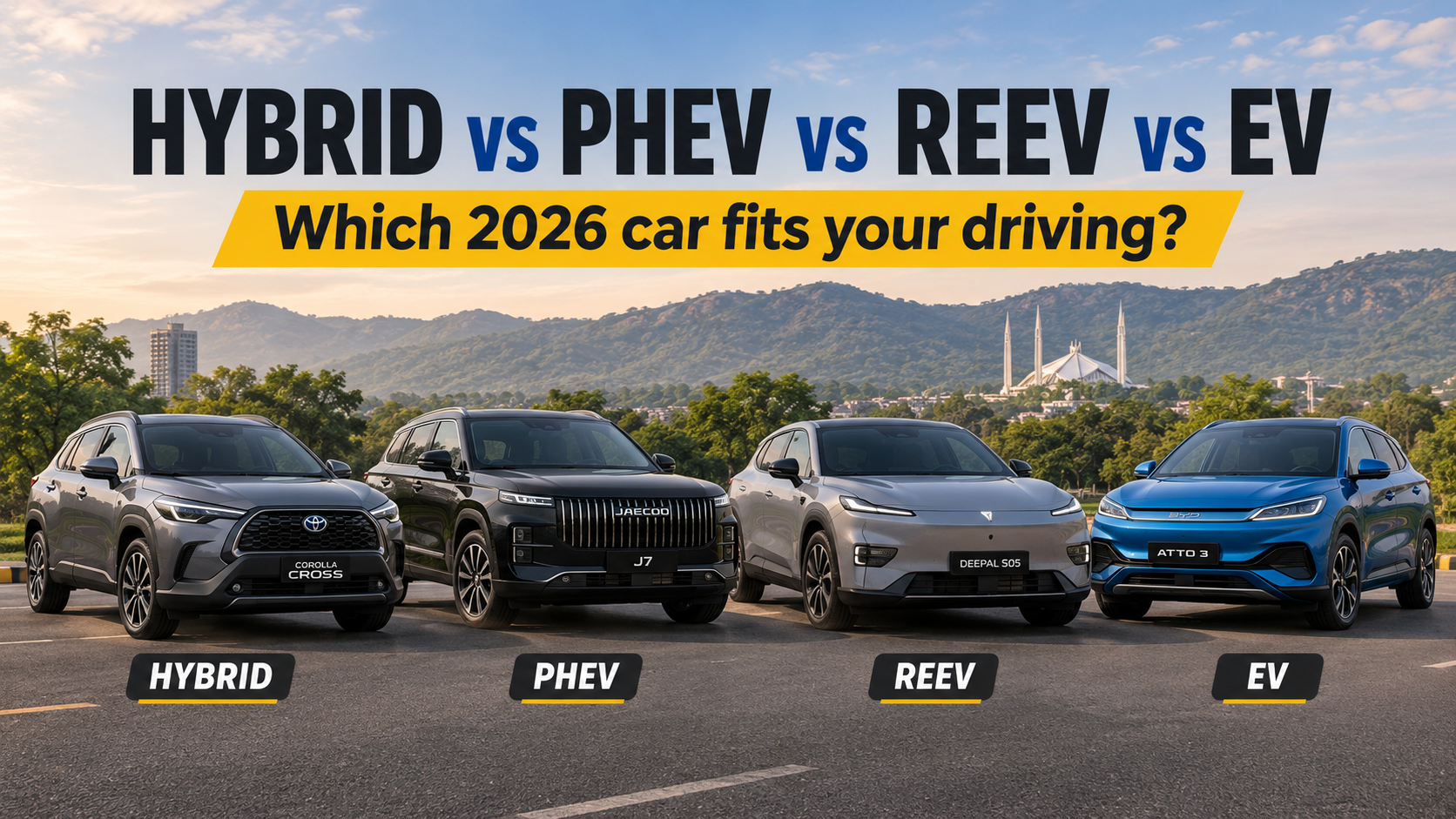
So you are thinking of changing your vehicle, and want to move to a battery powered car? But which one is for you and which one isn’t? Today’s topic is pretty about that. Which car suits your needs? Hybrid vs PHEV vs REEV vs EV. We are going to see what each of these technologies are, what they have to offer, what they lack, and which one is for you?
In one of the previous blogs I have already discussed what these technologies are but in this blog we will dive deeper and see what kind of electric technology suits which kind of consumer.
Things were pretty simple a decade or so ago. All you had were diesel or petrol engines to choose from. But as it is with every other industry, the innovation and technological advancements were inevitable. Where the diesel industry went through a massive diesel gate in Europe when the Volkswagen group was cheating about the emissions of their diesel cars. Japanese car makers like Toyota and even Honda to some extent decided to stick with the conventional petrol engine but bring electric power to it for better fuel consumption overall.
But before we start, we need to understand why the electrification of automotive technology is important. The fact of the matter is that the petrol prices have been the bane of the automotive consumers in Pakistan since ages. We get daily petrol price revisions and I think it is fair to say that for any middle or lower middle class family that relies on the mobility from their small car has been unable to properly budget their household due to these daily revisions.
Similarly the price of electricity has jumped high since 2022 and it has become even more hard even for a conventional electric vehicle owner to manage the cost of electricity low while being mobile.
This brings the whole case of electric vehicles. Considering the influx of cheap Chinese EVS and other electric vehicles, it is fair to say that there is a case if you can afford a new vehicle by disposing of your older conventional car that has something like a conventional internal combustion engine, whether it is petrol or diesel.
Pakistan vs the Automotive Electrification
After suffering a historic 69% contraction in 2023, the local auto sector rebounded sharply by growing 52% in 2024 and another 40.2% across full-year 2025, with the year 2026 maintaining double-digit momentum.
More importantly, the policy and infrastructure ground beneath buyers has shifted significantly over the last 18 months:
The National Electric Vehicle (NEV) Policy 2025–30:
Approved by the federal government in mid-2025, this policy targets 30% new energy vehicle penetration by 2030, backed by tariff protections for local assembly. The policy is also pushing to slash Pakistan’s roughly $16 billion annual petroleum import bill.
Charging Tariff Relief:
In early 2025, the federal government cut electricity tariffs for public EV charging stations by roughly 45% (over Rs 30 per unit, bringing base station tariffs down toward Rs 39/unit before taxes) to encourage commercial charger rollouts.
Charging Infrastructure Reality:
Despite regulatory targets to reach 3,000 charging stations by 2030 (and private pledges like BYD’s 128-charger network rollout), Pakistan still has fewer than 50 publicly accessible fast-charging stations nationwide as of 2026, heavily concentrated in Karachi, Lahore, Islamabad, and along the M-2 Motorway.
The September 2026 Tax Restructuring (S.R.O. 1525):
When concessional hybrid taxes expired on June 30, 2026, all hybrids jumped to the standard 25% sales tax bracket. On September 13, 2026, the Finance Division issued S.R.O. 1525(I)/2026, lowering General Sales Tax (GST) back down to 18% for locally manufactured HEVs up to 2,000cc. Crucially, PHEVs were left out of that reduction, keeping plug-in hybrids stuck at the higher 25% GST rate.
Local Assembly Expansion:
Pakistan’s automotive landscape has changed drastically thanks to the arrival of Chinese New Energy Vehicle (NEV) giants. Master Changan introduced Pakistan’s first CKD range-extended electric vehicle (the Deepal S05 REEV). Introduced by the Nishat group, Omoda and Jaecoo crossed 15,000 locally assembled units within a year of starting deliveries. And also, BYD’s purpose-built NEV assembly plant in Gharo entered its final validation phase for Q4 2026 commissioning.
Now that we have a clear picture of how Pakistan has been shaping and what are the imminent changes, let’s jump back to the original question of what kind of electric vehicle suits you.
Hybrid
In my opinion, it is fair to say that the hybrid vehicles were basically what started as the electrification Revolution of the automotive sector throughout the world.
Hybrid vehicles are also known as self-charging hybrids. It is a fairly simple formula where you have an internal combustion engine made into an electric motor that is usually powered by a small battery pack, which is typically around 1.0 kWh to 1.8 kWh. The engine is your primary driving force whereas the electric motor and the battery only assists when the car is usually idling or if there isn’t any heavy load on the engine.
The vehicle usually stays in electric mode when the speeds are around 30 to 40 km per hour for a short period of time since the battery is rather small.
Since hybrid technology was the start of electrification of automobiles, it is understandable that these vehicles are not exactly for longer runs on full electric mode. Although the second generation Toyota Prius was the vehicle that started the love affair of hybrid vehicles, things have changed quite a lot in the last decade or so. There are a lot of brand new hybrid vehicles available in Pakistan right now as well.
In Pakistan, this is arguably the most mature and widely accepted electrified segment. Spanning everything from a mild hybrid like Suzuki Fronx Hybrid (PKR 6.40 million) to Honda HR-V e:HEV to the Toyota Corolla Cross HEV (around PKR 10.30 million), Hyundai Tucson Hybrid (PKR 12.20–13.30 million), and Haval H6 HEV (PKR 11.50 million).
Following September 2026’s S.R.O. 1525 reducing GST on locally assembled sub-2000cc HEVs back to 18%, prices across several of these models dropped by Rs 375,000 to over Rs 1 million.
Advantages:
The biggest advantage of owning such a vehicle is that you are literally not changing anything in terms of running the vehicle like you run your normal petrol car. You just fill up your car’s fuel tank and you are good to go from Karachi to Islamabad without any worries.
And although the battery and the electric motor are small, the savings on fuel prices are quite significant.
And the fact these vehicles are like cash and you can just dispose of them whenever you want and get almost all of your money back.
Downsides:
The biggest downside is its smaller motor and battery pack at the end of the day. When you are cruising at motorway or highway speeds, the battery and the motor will not do anything to save you money. You are basically basically running on a petrol engine all the time.
The price of a battery pack can be a little higher than expected. And the fact the older hybrid vehicles like the Prius and the Civics have been in the market for a long period of time and require replacement of battery packs rather frequently.
PHEV
After the hybrid, the next step was to improve the charging ability of the batteries. That brought us the PHEV (plug-in hybrid electric vehicle) technology. The game plan was simple. You do not just charge the batteries in your vehicle with the car’s onboard internal combustion engine, but you also make it possible for the owner to just plug in the car in their homes regular 110 or 220 volt sockets and just charge the batteries overnight. This not only improved the overall fuel consumption average of the vehicle but the engineers were able to fit bigger batteries. By making the charging system capable of being charged by the regular AC or in some cases a dedicated high power DC charger, engineers were able to reduce the electricity generation load from the engine and just give long range EV mode of the vehicle through this out-board charging system.
The PHEV basically bridges the gap between a hybrid vehicle and a full electric by having a bigger motor and a bigger battery to give you long range as well as having a home charging ability.
In the earlier iterations the engines were naturally aspirated but things have changed now especially with the Chinese vehicles that come usually with a 1.5 l turbocharged engine and a battery pack of around 18 to 35 kWh.
Some of the new phev models available in pakistan include:
GWM Haval H6 PHEV (19.09 kWh battery, PKR 10.85–12.90 million)
Chery Tiggo 8 PHEV (around PKR 11.0 million)
Omoda 7 SHS-P (around PKR 10.65 million)
Advantages:
The biggest advantage is the long range of the vehicle in its electric mode. Secondly, considering these vehicles as mentioned above usually come with a turbocharged engine as well as heavier electric motor. That means you get some pretty decent performance figures. You easily get 300 to 500 BHP vehicles thanks to this combination. Tiggo 9 PHEV makes 610 horsepower and 920 Nm of torque which is some serious power if we are being honest.
And lastly you get the ability to charge your vehicle in your homes. And some of the new vehicles also offer Vehicle-to-Load (V2L) capability that lets you power your household appliances during a power outage thanks to the massive battery bank.
Downsides:
The biggest con of buying a new PHEV in Pakistan right now, in my opinion, is having to pay a sales tax of 25%. The S.R.O. 1525 in September 2026 excluded plug-in hybrids. That means the PHEVs continue to carry the 25% sales tax rate, pushing their showroom prices noticeably higher than comparable HEVs.
Also, just because you have the charging ability, it does not mean you will always get a chance to charge the vehicle. People who live in high-rise buildings or flats might not be able to enjoy this feature unless they have a dedicated parking spot with a dedicated power outlet for their vehicles. And it is also a fact that sometimes you just forget to charge your vehicle even though you had the means to do it. That means you are basically missing on cheaper mileage by charging on electricity than running on petrol power.
REEV
REEV stands for Range-Extended Electric Vehicle. It is basically the newer iteration of the combination of an electric motor and an internal combustion engine. But rather than having an engine to drive the vehicle and electric motor to assist it, REEV only uses an electric motor to drive the vehicle and uses the internal combustion engine as a permanent onboard electricity generator to charge the batteries.
Some of the available and some to be available REEV models in Pakistan are;
Deepal S05 (27.28 kWh battery, PKR 9.99 million)
ArcFox T5 (PKR 10.2–10.5 million)
Forthing Friday (PKR 9.99 million)
But if you look in the past, the Nissan Note e-Power was the first REEV that was available in Pakistan as a Japanese used car import.
Since reeve and phev, both vehicles come with an external charging port as well as an engine and a fuel tank, sometimes people confuse their drivetrain technologies as well. But the reality is that they have completely different mobility systems. In a PHEV, the engine is directly and mechanically linked with the wheels and is the primary source of the rotation.
On the other hand, a REEV is 100% electric-drive at all times. In a REEV vehicle, the engine has literally no direct connection with the wheels. The power from usually a small 1.0 to 1.5L internal combustion engine goes to the battery in the form of electricity. Its battery is larger than a typical PHEV’s (usually 27–32 kWh, giving 125 to 190 km of real-world electric range). And then that electricity runs the electric motors that are directly connected with the wheels of the vehicle. When the battery drops to around 15–20%, the petrol engine fires up at a steady, optimal RPM to generate electricity and feed the battery or electric motor.
Advantages:
The biggest advantage is that there is no range anxiety like you get in a fully electric vehicle even though reeve itself is 100% full electric experience. And that is thanks to its onboard generator in the form of its internal combustion engine that provides steady charging to the batteries. You can easily run your vehicle for 100 to 150 km on the batteries in a single charge without the fear of batteries running dry.
Secondly, reeve offers rather simpler drivetrain mechanics than a phev. The phev comes with a direct hybrid drive gear system, whereas the REEV only has motors to drive the vehicle and virtually no gearbox in between.
And since the engine is only there to provide electricity to the batteries, the car makers make sure that the engine runs at thermally optimal RPM range consuming as less fuel as possible while providing maximum charge.
Downsides:
Just because you have an onboard generator, it does not mean that you do not need to charge your vehicle. Charging your vehicle is a must. The engine is only there as a guarantee in case you do not run out of the charge.
Also let’s say you have depleted your onboard battery and the engine has kicked in to charge them. If you are travelling at high speeds on a motorway, the engine and the battery management system are going to have a struggle to maintain the charge for the vehicle to keep running at a consistent high speed. Converting petrol into mechanical energy and then into electricity and then back into mechanical wheel spinning torque at a runtime, I must say, is a tough ask from such a small setup in a vehicle.
EV
EV also known as BEV (battery electric vehicle) are the latest and greatest electricity power has to offer. There is no internal combustion engine or complex gearboxes to help you drive the vehicle. It is all batteries and electric motors. There is usually a massive lithium ion (usually LFP in Pakistan) battery neatly installed on the floor of the vehicle that feeds the power to usually one and sometimes two electric motors.
Since it is just an electric motor, you get all of the torque at 0 RPM. And since there is no internal combustion engine, the vehicle is practically vibration free. The absence of engine noise and vibrations makes your daily commute rather comfortable compared to doing the same runs on a vehicle with an internal combustion engine.
Some of the BEVs available Pakistan are:
BYD Atto 2 (45.12 kWh battery, priced at PKR 73 lakh)
Jaecoo J5 EV (49.5 kWh battery, introduced at PKR 60 lakh)
MG ZS EV (51.1 kWh battery priced at PKR 96.90 to 1.50 Crore)
Honri Ve 2.0 / 3.0 (18.5 / 29.9 kWh battery priced at PKR 36 – 46.5 lakh)
Dongfeng Box (32.0 / 42.3 kWh battery, priced at PKR 55 – 68 lakh)
Advantages:
The biggest advantage of owning an electric vehicle is to low cost of running. The price of electricity is still cheaper than the cost of petrol when you compare the money spent in rupees per kilometre.
Other than that the electric vehicles are sort of maintenance free. You do not need the regular maintenance like oil and oil filter change, spark plug change, air filter change, etc.
And lastly, since the Pakistan government is heavily pushing towards electrification, they provide significant tax cuts to new owners who are switching from conventional vehicles to electric vehicles. The sales tax on electric vehicles is significantly less than in normal vehicles.
Downsides:
The battery and the battery charging technology is still in its infancy. That means batteries take a significant amount of time to charge compared to just stopping at a gas station and filling up your car’s fuel tank.
Also the charging infrastructure in Pakistan is nowhere near than what it is in something like Europe or the United States. You do not get fast charges readily available if you are travelling from one city to another . So the range anxiety is pretty much a reality. You end up calculating the charge and the kilometres in your mind all the time.
Also, even though sometimes vehicle manufacturers boast about the high mileage of their electric vehicles, the reality is that the real time range of these batteries is usually significantly less than what is stated. If a car says that it will do 300 km on a full charge. But when you run it in extreme summers at high speeds with full AC on, the high chance is that the range will drop to 160 or 180 km.
Also, like any battery powered appliances like your mobile phone or an emergency light, it is a fact that a battery loses its ability to hold the charge due to multiple charging cycles as the time passes. And since the battery is the lifeline of these vehicles, the cost of replacement battery is significantly higher than just swapping a used Kabuli engine in your Corolla or Civic.
As I have said earlier, battery powered vehicles are still a new thing in Pakistan. And considering that Pakistanis buy vehicles as an asset rather than just a mode of transportation, the question is how well the used electric vehicles will be selling in 8 to 10 years. Will they be able to retain their resale value like a normal petrol-powered Corolla or Honda does?
Official 2026 Warranty Coverage in Pakistan
Manufacturers entering Pakistan have backed their high-voltage components with some seriously impressive warranty windows. Here are some of the examples from the locally available high end electric vehicles:
BYD Pakistan (Atto 2, Atto 3, Seal): 6 years / 150,000 km vehicle warranty and 8 years / 160,000 km on the high-voltage Blade battery (guaranteeing at least 70% state-of-health retention).
Master Changan Deepal S05 REEV: 5 years / 150,000 km vehicle warranty and 8 years / 240,000 km on the CATL LFP battery pack.
Haval Pakistan (H6 HEV & H6 PHEV): 6 years / 150,000 km standard vehicle warranty and 8 years / 160,000 km on the battery, electric motor, and controller.
Hidden Costs
While a pure BEV skips engine oil changes completely, REEVs, PHEVs, and HEVs still require scheduled engine oil and filter changes (typically every 10,000 km or 6–12 months). This applies even if you drive a REEV or PHEV 90% on electric power.
Petrol sitting in a fuel tank for months degrades, and an engine that only fires up occasionally for 10-12 minutes at a time can accumulate moisture in the oil sump. Skipping dealership service intervals just because your odometer was mostly electric is the fastest way to void that 8-year battery warranty.
Also, all of these new companies charge some serious bucks for maintenance trips to their respective workshops – even if it is just an ECU software update.
Needless to say, there are way too many unknowns when it comes to battery electric vehicles.
Side by Side Comparison of all Four Technologies
Feature / Metric
Pure EV (BEV)
Range-Extender (REEV)
Plug-in Hybrid (PHEV)
Conventional Hybrid (HEV)
What Drives the Wheels?
Electric motor(s) only
Electric motor(s) only
Electric motor + Petrol engine
Electric motor + Petrol engine
Role of Petrol Engine
None
Onboard generator only
Directly drives wheels & charges
Directly drives wheels & charges
Needs Plug-in Charging?
Yes (Mandatory)
Yes (Recommended)
Yes (Recommended)
No (Self-charging)
Typical Battery Size (2026 PK)
45 – 85 kWh
27 – 32 kWh
18 – 35 kWh
1.0 – 1.8 kWh
Pure Electric Range (Real-World)
280 – 480 km
120 – 160 km
65 – 95 km
2 – 4 km (low-speed creeping)
Total Range (Full Charge + Tank)
280 – 480 km
1,000 – 1,150 km
950 – 1,100 km
750 – 900 km
Typical 2026 Price Bracket (PKR)
6.0M – 16.0M+
9.9M – 12.5M
10.6M – 22.5M
6.4M – 15.0M
Current GST Treatment (Late 2026)
Concessional / CKD Exempt
EV/NEV Category Specific
25% GST (Excluded from SRO 1525)
18% GST (Local ≤2000cc)
2026 Popular Pakistani Examples
BYD Atto 2, Jaecoo J5 EV, Deepal S07
Deepal S05 REEV, ArcFox T5 REEV
Haval H6 PHEV, Chery Tiggo 8 PHEV
Corolla Cross HEV, Haval H6 HEV, Fronx
Running Cost Reality Check: 1,500 km Per Month in Pakistan
To see how these numbers play out in real rupees, let’s model a typical Pakistani urban driver covering 1,500 km per month (roughly 50 km per day) using November 2026 energy benchmarks:
Standard Petrol SUV like Tucson or Sportage (10 km/L average):
Uses 150 litres of petrol = PKR 50,700 / month.
Conventional HEV (18 km/L city average):
Uses ~83 litres of petrol = PKR 28,050 / month (Saves ~PKR 22,650/month).
PHEV or REEV (Charged at home daily; 85% electric, 15% petrol):
~1,275 km on electricity (~230 kWh @ PKR 60/unit = PKR 13,800) + ~225 km on petrol (~15 litres = PKR 5,070) = PKR 18,870 / month on grid power, or under PKR 7,000 / month with home solar.
Pure BEV (100% charged at home):
1,500 km (~255 kWh @ PKR 60/unit) = PKR 15,300 / month on grid power, or effectively free on surplus home solar.
Notice the crucial takeaway here: if you have home solar and a dedicated parking spot, a BEV, REEV, or PHEV slashes your monthly fuel bill by over PKR 40,000. Conversely, if you never plug in a PHEV or REEV, its monthly fuel bill jumps to roughly PKR 36,000 to 42,000, making it more expensive to run than a regular HEV.
Which Powertrain Fits you the Best
Choosing the right 2026 powertrain comes down to your daily routine and parking situation rather than chasing technical acronyms. A Pure EV (BEV) like the BYD Atto 2 or Jaecoo J5 EV makes the most sense if you have a dedicated parking spot at home with a wall charger. And if there is a solar system installed at your home, then you are gold. Provided 90% of your driving stays within city limits, it gives you the lowest maintenance costs and virtually free city commuting. Also, if it is not going to be your primary car and you already have a main vehicle, an EV as a side kick is a way to go.
But if you only have one primary family car and frequently travel between cities, a REEV or PHEV bridges the gap without range anxiety. Deepal S05 is one of those REEVs that delivers a true electric driving feel with over 120 km of real-world battery range yet having a backup generator inside the car in the form of its internal combustion engine. Bigger cars like the Chery Tiggo 8 or even Tiggo 9 and the Haval H6 or Omoda 7 are for people who want big powerful vehicles with a lot of luxuries and features and yet having massive batteries to run on clean electric modes while also having the luxuries to run their inbuilt fully operational and powerful internal combustion engines. But keep in mind the 25% extra GST on these vehicles before buying them.
In the end, if you do not want to get in any of the hassles of big battery cars, simply get a good ol’ reliable hybrid electric vehicle. You get some battery assistance and some cost cutting but it makes the most sense if you do not have a dedicated fast charger accessible to you. Backed by September 2026’s GST reduction to 18% on locally assembled models, hybrids from Toyota, Hyundai, Honda, Haval, and Suzuki require zero lifestyle changes while delivering decent fuel economy, reliability, and resale value.
BYD’s premium automotive brand, Denza, has demonstrated the power of its plug-in hybrid technology by towing a 180-tonne Boeing 747 aircraft using just two wheels of its B5 SUV. The demonstration took place at Dunsfold Aerodrome in Surrey, UK, on November 18, 2026, showcasing the SUV’s electric motor performance and advanced traction capabilities.
According to Denza, the challenge marked the first time a production vehicle had towed an aircraft on two wheels. It also marked the first time a Boeing 747 had been pulled using electric power alone.
How Did the Denza B5 Pull a Boeing 747?
The demonstration involved three towing attempts, each designed to test the vehicle under increasingly challenging conditions.
During the first attempt, the SUV pulled the aircraft using all four wheels. Engineers then removed one wheel and installed 2,000 kg of additional ballast to improve traction.
For the final attempt, the SUV operated on only two wheels, with 4,500 kg of ballast and specially fitted stabilisers maintaining its balance.
Across all three attempts, the Denza B5 moved the Boeing 747-400 a combined distance of 1,600 metres.
The aircraft, which retired from active service in 2020, still retained its engines and furnished interior.
What Makes the Denza B5 So Powerful?
The Denza B5 uses BYD’s Dual Mode Off-road (DMO) plug-in hybrid system, combining a 1.5-litre turbocharged petrol engine with electric motor technology.
Its UK-specification Ultimate variant offers:
Combined power: 544 PS
Maximum torque: 760 Nm
Battery capacity: 31.8 kWh
Electric driving range: Up to 90 km (WLTP)
Combined driving range: Approximately 864 km
Kerb weight: 3,035 kg
Official towing capacity: 2,500 kg
Despite being a plug-in hybrid, the SUV completed the aircraft-pulling challenge using electric propulsion without requiring its petrol engine to drive the wheels.
How Can an SUV Move 180 Tonnes?
The explanation lies in rolling resistance and electric motor torque.
Although the Boeing 747 weighs approximately 180 tonnes, its weight remains supported by its landing gear. Consequently, the SUV does not need to lift the aircraft or drag its full weight across the ground.
Instead, it must generate sufficient pulling force to overcome rolling resistance.
Electric motors provide strong torque at low speeds, while the additional ballast improves tyre grip and reduces wheelspin.
However, the demonstration took place under controlled conditions. The Denza B5’s official towing capacity remains 2,500 kg, not 180 tonnes.
What Does This Mean for Pakistan?
The demonstration highlights how Chinese manufacturers are advancing plug-in hybrid technology beyond conventional fuel-efficiency improvements.
For Pakistani buyers, such developments could increase interest in electrified SUVs, particularly as more hybrid and electric vehicles enter the local market.
There is currently no confirmed Pakistan launch announcement for the Denza B5.
Vehicle owners in Lahore could soon face restrictions on transferring their cars or motorcycles if they have unpaid electronic traffic fines. According to reports published on November 18, 2026, authorities are considering linking outstanding e-challans to vehicle ownership transfers to recover overdue penalties.
The proposal comes as more than 735,000 motorists in Lahore reportedly have unpaid digital traffic challans, raising concerns about compliance with traffic regulations.
Vehicle Transfers Could Be Blocked Until Fines Are Paid
The proposed restriction was discussed during a meeting between Lahore Chief Traffic Officer (CTO) Syed Abdul Raheem Shirazi and Senior Civil Judge (Criminal Division) Muhammad Jameel Bhatti.
Officials discussed approaching the Punjab Excise Department to explore blocking vehicle ownership transfers until outstanding digital challans are cleared.
If implemented, motorists with unpaid fines could face difficulties selling or transferring their vehicles, potentially affecting Lahore’s used-car market.
However, the restriction has not yet been confirmed as an officially implemented rule. Authorities have not announced an enforcement date or detailed implementation procedure.
Over 8,500 Court Summons Issued in One Week
Lahore traffic authorities are also strengthening legal action against motorists who fail to pay their fines.
According to CTO Shirazi, unpaid digital challans are forwarded to the relevant courts after 10 days under the prescribed procedure.
Courts subsequently issue summons to defaulters at their registered residential addresses, directing them to settle outstanding penalties.
During the week preceding the announcement, 8,560 court summons were reportedly issued to motorists with unpaid challans.
Officials also highlighted cases in which motorists avoided collecting confiscated documents to escape additional penalties.
What Does This Mean for Used-Car Buyers?
The proposed restriction could introduce another verification requirement for people buying and selling used vehicles in Lahore.
For example, someone purchasing a Toyota Corolla, Honda City, or Suzuki Alto could face ownership transfer delays if unresolved traffic fines are linked to the vehicle.
Buyers should therefore check the vehicle’s e-challan history before completing a transaction.
Important precautions include:
Verify pending e-challans: Check whether the vehicle has outstanding digital traffic fines.
Request payment receipts: Ask sellers to provide proof that outstanding fines have been cleared.
Complete the transfer promptly: Ensure ownership is officially transferred after purchasing the vehicle.
Sellers should also resolve outstanding penalties before listing their vehicles to avoid potential transaction delays.
Could This Affect Lahore’s Used-Car Market?
Although the proposal does not introduce additional vehicle taxes or registration fees, it could make ownership verification more important.
Vehicles with unresolved challans may become harder to sell if transfer restrictions are enforced. Disputes over outstanding fines could also delay transactions between buyers and sellers.
Key Takeaways
More than 735,000 motorists reportedly have unpaid digital traffic challans in Lahore.
Authorities are considering restrictions on ownership transfers for defaulters.
Courts reportedly issued 8,560 summons within one week.
The proposed transfer restriction is not yet confirmed as operational.
Used-car buyers should verify outstanding fines before finalizing purchases.
Pakistan’s Federal Board of Revenue (FBR) has upheld the electric vehicle classification of Range-Extended Electric Vehicles (REEVs), rejecting an appeal filed by Indus Motor Company (Toyota Indus). The decision, issued on November 16, 2026, confirms that certain REEV models will continue to be classified as electric vehicles rather than hybrids for customs purposes.
The ruling specifically concerns the Deepal S05 REEV and Forthing Friday REEV, both of which will remain classified under Pakistan Customs Tariff (PCT) subheading 8703.80.
Why Did Toyota Indus Challenge the REEV Classification?
Toyota Indus questioned whether vehicles equipped with petrol engines should receive the same customs classification as fully electric vehicles.
The automaker argued that REEVs contain internal combustion engines and should therefore fall under the hybrid vehicle category.
It also raised concerns about differences in taxation between competing technologies, suggesting that preferential treatment for REEVs could create an uneven playing field for established hybrid manufacturers.
According to PakWheels, the appeal was heard at FBR headquarters in Islamabad on November 5, 2026, before the authority upheld the existing classification.
Why Does FBR Consider REEVs Electric Vehicles?
The dispute primarily centered on how REEV technology works.
Unlike conventional hybrid vehicles, which can use petrol engines to drive the wheels directly, REEVs rely exclusively on electric motors for propulsion.
Their onboard petrol engines operate as generators, producing electricity to recharge the battery and extend driving range.
Based on this technical distinction, the FBR maintained that the Deepal S05 REEV and Forthing Friday REEV qualify under PCT subheading 8703.80.
The classification means that having a petrol engine does not automatically make a vehicle a hybrid under Pakistan’s customs regulations.
What Does the Decision Mean for Pakistani Car Buyers?
For consumers considering electrified vehicles, the ruling provides greater clarity about REEV technology and its regulatory treatment.
REEVs could be particularly attractive to Pakistani motorists concerned about limited public charging infrastructure, especially those frequently trave between cities.
Their petrol-powered generators allow drivers to extend their journeys without depending entirely on charging stations.
However, the FBR decision does not automatically mean lower vehicle prices.
Final prices depend on applicable duties, taxes, exchange rates, import costs and manufacturer pricing decisions. No immediate price reductions have been confirmed following the ruling.
How Will the Ruling Affect Pakistan’s Auto Industry?
The decision offers greater certainty to manufacturers and importers introducing REEV technology into Pakistan.
For Toyota Indus and other established automakers, it also highlights ongoing concerns about taxation differences between hybrid and electric powertrains.
As Pakistan’s electric vehicle market expands, consistent customs classifications and transparent tax policies will remain essential for encouraging investment and consumer confidence.
The decision marks another development in Pakistan’s evolving automotive landscape, where new vehicle technologies are increasingly challenging traditional distinctions between petrol, hybrid and electric cars.
Pakistan’s auto financing reached a record Rs416.54 billion in October 2026, marking another month of growth in bank-funded vehicle purchases. According to the latest data from the State Bank of Pakistan (SBP), outstanding car loans increased by 32.07% compared with the same period last year, reflecting continued momentum in the country’s automobile financing sector.
The figures indicate growing activity in vehicle financing, although higher borrowing does not necessarily mean cars have become more affordable for Pakistani buyers.
Auto Financing Records 23 Consecutive Months of Growth
According to SBP data, outstanding automobile financing increased from Rs407.12 billion in September 2026 to Rs416.54 billion in October, representing a month-on-month increase of 2.31%.
On a yearly basis, financing rose from Rs315.40 billion in October 2025, an increase of approximately Rs101.14 billion.
This marks the 23rd consecutive month of growth in outstanding auto loans, with October’s figures surpassing the previous record set in September.
The sustained increase highlights the growing role of bank financing in Pakistan’s automobile market, where high vehicle prices make upfront purchases difficult for many consumers.
What could be driving Auto Financing Growth?
Several factors may be contributing to the rising demand for automobile financing, including changing consumer purchasing preferences, availability of financing options, and activity in the local car market.
For buyers unable to pay the full vehicle price upfront, bank financing offers an alternative through down payments and monthly instalments.
However, financing charges, insurance costs and other associated expenses can significantly increase the total amount paid for a vehicle.
Interest rates also remain an important consideration, as changes in borrowing costs directly affect monthly instalments and overall affordability.
Importantly, the SBP figures represent outstanding loan balances rather than the number of new car loans issued during October.
What Does This Mean for Pakistan’s Auto Industry?
The continued growth in vehicle financing is an encouraging indicator for Pakistan’s automobile industry, particularly for local assemblers such as Indus Motor, Pak Suzuki, and Honda Atlas, as well as emerging Chinese automotive brands.
Greater access to financing could support vehicle demand, particularly among customers who prefer instalment-based purchases.
However, the increase in outstanding loans does not automatically translate into higher vehicle sales.
Actual market performance will also depend on car prices, inflation, financing costs and purchasing power.
Industry observers will be watching whether the financing trend translates into stronger sales reported by the Pakistan Automotive Manufacturers Association (PAMA) over the coming months.
Key Highlights and Industry Outlook
Record financing: Outstanding auto loans reached Rs416.54 billion in October 2026.
Monthly growth: Financing increased 2.31% compared with September.
Annual increase: Auto financing grew 32.07% year-on-year.
Positive momentum: Outstanding loans have increased for 23 consecutive months.
Future outlook: Vehicle affordability, borrowing costs and consumer demand will determine whether financing growth leads to stronger car sales.
While Pakistan’s automobile financing sector continues to expand, the real test will be whether this momentum translates into sustainable vehicle sales and improved access to car ownership.
The federal government has decided to restrict vehicles without valid fitness and emission certificates from entering Islamabad as part of new measures to combat smog and air pollution. The decision was announced on November 17, 2026, following a meeting chaired by Minister of State for Interior Talal Chaudhry.
Officials reviewed Islamabad’s Air Quality Index (AQI) and directed relevant departments to strengthen environmental enforcement. However, authorities have not yet announced when the vehicle entry restrictions will take effect or how certificates will be checked.
Which Vehicles Will Be Restricted?
Under the announced measures, vehicles without valid fitness and emission certificates could be denied entry into the federal capital.
The restrictions are intended to reduce pollution from poorly maintained and smoke-emitting vehicles. Authorities have also ordered action against open burning, polluting brick kilns, and industrial units, with fines and legal proceedings possible for environmental violations.
The government has not clarified whether the restrictions will apply equally to private cars, commercial vehicles, and motorcycles. Details regarding exemptions, testing locations, and enforcement procedures are also awaited.
Punjab Already Enforcing Vehicle Emission Testing
While Islamabad prepares its restrictions, Punjab has introduced a structured vehicle emission-testing programme through the Private Vehicle Inspection and Certification System (PVICS).
According to a Dawn report published on November 13, 2026, motorists in Punjab must obtain emission certificates for vehicles that fall outside the applicable exemption periods.
Vehicle Emission Testing Fees in Punjab
Engine Capacity
Testing Fee
Up to 1,000cc
Rs500
Above 1,000cc–1,500cc
Rs800
Above 1,500cc–2,500cc
Rs1,000
Above 2,500cc–4,500cc
Rs1,500
Above 4,500cc
Rs2,000
Source: Punjab Provincial Transport Authority’s notified fee schedule.
Punjab also provides initial exemptions based on vehicle manufacturing date and engine capacity:
Up to 1,000cc: Five years
1,001cc–2,000cc: Six years
Above 2,000cc: Seven years
These exemptions are specific to Punjab and should not be assumed to apply to Islamabad.
How Does Vehicle Testing Work?
Punjab has established 28 testing centres in Lahore, with additional facilities operating in other districts.
The computerised inspection typically takes two to three minutes and assesses exhaust emissions, braking, suspension, tyres, headlights and other mechanical components.
Vehicles passing the required standards receive a certificate valid for one year. Those that fail must complete necessary repairs before reassessment, which costs half the original testing fee.
Motorists should also understand that emission certificates and statutory vehicle fitness certificates can be separate requirements, particularly for commercial vehicles.
Punjab’s December 31 Deadline
The Punjab government has extended its emission-testing compliance deadline to December 31, 2026.
Vehicles requiring certification that fail to comply may face challans and fines after the deadline.
Islamabad’s proposed entry restrictions remain a separate federal measure, with the implementation date still unconfirmed.
What Does This Mean for Car Buyers?
For Pakistani motorists, vehicle maintenance is becoming increasingly important beyond routine servicing.
Owners should address excessive exhaust smoke, engine faults and other mechanical problems before seeking certification.
Used-car buyers should also consider professional inspections to assess engine health and mechanical condition before purchasing. However, a general vehicle inspection does not replace an officially recognised emission or fitness certificate.
The Islamabad decision does not constitute a nationwide ban on older cars, nor has the government announced a specific vehicle-age restriction.
Key Takeaways
Islamabad plans to restrict vehicles lacking valid fitness and emission certificates.
The enforcement date and detailed checking procedures remain unannounced.
Punjab’s emission-testing fees range from Rs500 to Rs2,000.
Punjab’s compliance deadline is December 31, 2026.
Regular maintenance and official testing could help motorists avoid future penalties.
Pakistan’s growing focus on vehicle emissions may increase demand for maintenance, diagnostics, and certified inspections. Motorists should follow official announcements before making decisions about vehicle replacement or travel restrictions.
The Pakistan Solar Association (PSA) has urged the federal government to introduce a nationwide price ceiling for electric vehicle (EV) charging services after reports of some stations charging up to Rs150 per unit. The proposal, reported by Business Recorder on November 15, 2026, aims to make public EV charging more affordable, transparent and predictable for motorists across Pakistan.
Why Are EV Charging Rates a Concern in Pakistan?
According to the association, some public charging stations, particularly along highways and motorways, reportedly charge between Rs100 and Rs150 per kilowatt-hour (kWh).
These prices have raised concerns about whether EV owners are benefiting from the government’s efforts to reduce charging costs.
Pakistan’s Power Division previously announced a 44% reduction in electricity tariffs for EV charging stations, bringing the rate down from Rs71 to approximately Rs39.70 per unit.
However, this rate applies to charging operators rather than directly determining what motorists pay. Public charging prices can also include infrastructure, equipment, maintenance and operating costs.
What Changes Has the Pakistan Solar Association Proposed?
The PSA has requested a uniform national pricing framework that would protect consumers from excessive charges while allowing charging station operators to earn reasonable returns.
Its recommendations include:
National price cap: Establish a maximum consumer rate for comparable EV charging services.
Transparent pricing: Display complete charging costs before each session.
Itemised billing: Show electricity consumption, applicable tariffs, taxes and additional charges.
Complaint mechanism: Allow motorists to report excessive or unclear charges.
Regular monitoring: Ensure charging operators comply with notified pricing rules.
The association has also called for consultations involving the Power Division, NEPRA, NEECA and other relevant authorities.
Will Electric Cars Become Cheaper to Run?
A nationwide charging price cap could reduce running costs for motorists who rely heavily on public charging infrastructure.
For example, charging an EV with 40 kWh of electricity would cost Rs6,000 at Rs150 per unit, compared with Rs4,000 at Rs100 per unit.
This difference can significantly affect the affordability of EV ownership, particularly for apartment residents without home-charging facilities and drivers who frequently travel between cities.
More predictable charging prices could also improve consumer confidence in Pakistan’s growing electric vehicle market.
However, any actual savings would depend on the maximum rate eventually approved by regulators.
Has the Government Approved the EV Charging Price Cap?
No official national consumer price cap has been confirmed under this proposal.
The association’s recommendations have been forwarded to relevant federal ministries for consideration. No final consumer price ceiling or implementation date was announced in the November 15 report.
Industry Takeaway
Public EV charging reportedly costs up to Rs150 per unit at certain locations.
PSA wants a nationwide ceiling and greater price transparency.
A reasonable cap could make EV ownership more financially predictable.
Government approval and implementation details remain pending.
For Pakistani buyers, affordable public charging remains an important factor in deciding whether switching from petrol to electric vehicles makes financial sense.
The Punjab government has opened online registration for its November 2026 auction of attractive vehicle registration numbers, allowing motorists to bid for their preferred number plates without visiting Excise Department offices. Applications are being accepted through the official e-Auction platform until November 30, 2026.
According to the Associated Press of Pakistan (APP), the digital auction is being operated by the Punjab Information Technology Board (PITB) in collaboration with the Punjab Excise, Taxation and Narcotics Control Department. The service is available for motorcycles, private cars and commercial vehicles.
How to Apply for Punjab’s Online Number Plate Auction
Vehicle owners can participate through the official Punjab e-Auction mobile application or web portal.
Applicants must create an account using their CNIC, mobile number and email address. After verifying their account, they can check available registration numbers and select their preferred option.
The application also requires the vehicle’s chassis number, which must match the relevant vehicle documents.
A non-refundable participation fee of Rs100 must be paid through the e-Pay system. Applicants must also deposit the applicable reserve price or average price, whichever is higher, before they can participate in bidding.
Each approved Automated Identification Number (AIN) permits bidding for one registration number. Separate applications are required for additional vehicles.
Reserve Prices for Premium Vehicle Numbers
The Punjab Excise Department has established minimum reserve prices for different categories of attractive registration numbers.
The published rates include:
Registration Number
Minimum Reserve Price
1
Rs10,000
7 and 786
Rs7,500
Other single-digit numbers
Rs5,000
Selected numbers, including 11, 22, 111 and 777
Rs5,000
Optional numbers 302 and 420
Rs2,000
The Rs5,000 category for selected repeating and other attractive numbers excludes motorcycles and rickshaws, while the Rs2,000 rate for numbers 302 and 420 applies to private cars and commercial vehicles.
These figures represent minimum reserve prices rather than guaranteed final costs. Competitive bidding may push the winning amount higher.
Bidding Rules and Payment Requirements
Under the Excise Department’s published e-Auction policy, participants can increase their offers in multiples of Rs500 for four-wheelers and Rs200 for other vehicles.
Successful bidders must pay the winning auction amount in addition to the prescribed vehicle registration fee.
Vehicle registration must generally be completed within 15 days of the auction result announcement. The department may grant an additional 30 days in exceptional circumstances.
Failure to meet the payment requirements can result in cancellation of the allocated number and forfeiture of the deposited reserve amount.
Winning a number also does not automatically authorize its display. Owners must complete the formal vehicle registration process before using the allocated registration mark.
What Does This Mean for Punjab Vehicle Owners?
The online auction offers a convenient alternative to traditional in-person bidding, particularly for buyers seeking memorable registration numbers for newly purchased cars or motorcycles.
PITB Chairman Faisal Yousaf described the platform as an initiative aimed at improving accessibility, efficiency and transparency in the auction process.
However, attractive registration numbers remain an optional expense. Buyers should consider the reserve price, potential bidding competition and regular registration charges before committing.
Key Takeaways
Registration deadline: November 30, 2026.
Participation fee: Rs100, non-refundable.
Minimum reserve price: Starts at Rs2,000 for certain optional numbers.
Bidding: Conducted through the official Punjab e-Auction platform.
After winning: Payment and vehicle registration requirements must be completed within the prescribed period.
Applicants can visit the official Punjab e-Auction portal to check available numbers and complete their registration before the deadline.