
Jaecoo J5 HEV vs BYD Atto 2: Hybrid or EV at Rs 7.5m

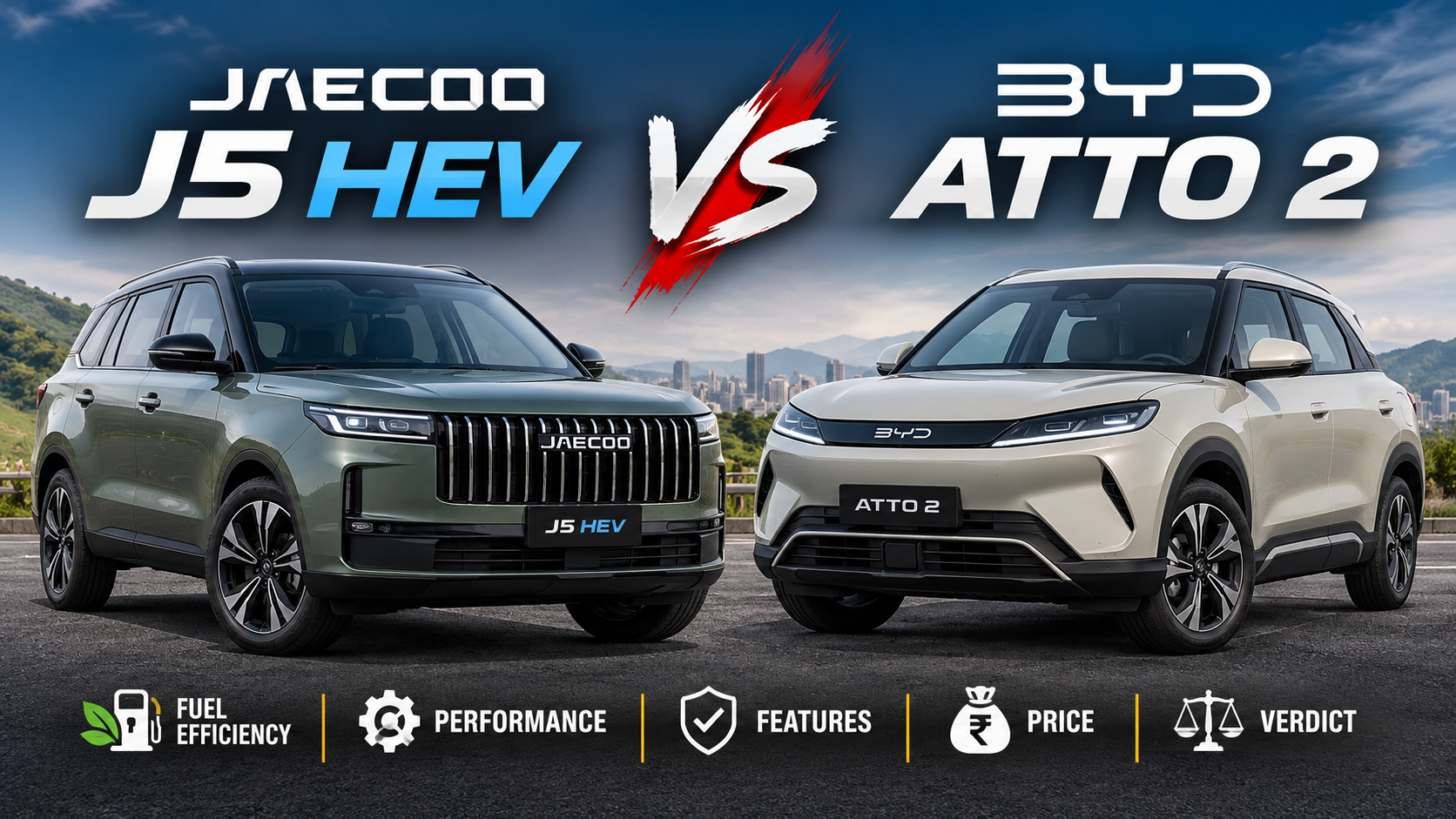
So we are back with another comparison blog and this time we are comparing Jaecoo J5 SHS-H against the BYD Atto 2. The first point you might be raising is why we are comparing a hybrid electric vehicle with a full electric when there already is a battery electric version of the Jaecoo priced at the highly competitive price of 6 million PKR. Well there are a couple of reasons.

Number one is that both are from Chinese manufacturers. Secondly, we are also going to see how a hybrid competes with a full electric in different driving conditions and scenarios.

I have previously mentioned in a few of my blogs that considering the high as well as ever fluctuating fuel prices in Pakistan it only makes sense if you start considering electric vehicles. The electric vehicle especially makes sense when you have a solar system installed in your household.

The idea is that you are basically running your vehicle free of cost and by cost I mean the cost of fuel the cost of maintenance cost of lubricants to name a few as well as the fact that taxes on electric vehicles are usually less than the vehicles with internal combustion engines like your regular Toyota Corolla or Honda civic or any midsize crossover SUV like Sportage etc.

It is a fact that Chinese car manufacturers are leading the way when it comes to electric vehicles. And it is also a fact that their prices are highly competitive compared to Japanese or European automakers. The Pakistani automotive market has swiftly moved past the hegemony of your big three that is Toyota Honda and Suzuki. If you look at the roads you will start to notice far more Chinese vehicles than what it was a few years ago. 

As I mentioned above, one of the reasons is they’re highly competitive prices and second reason is the type of technology that is being offered in that price tag is unbeatable by the automakers from other countries. You get top of the line safety and security measures in your vehicles as well as top of the line and industry leading battery technology.

So let’s cut to the chase and start our review and as always we will begin with the price comparison of both vehicles. 

Price

The BYD auto is available in just one variant whereas Jaco J5 is available in two variants, comfort and premium. Here are the prices of all three.

Model/VariantPrice in PKR
BYD Atto 2PremiumPKR 7,290,000 (Rs 72.90 Lacs) 
Jaecoo J5ComfortPKR 6,699,000 (Rs 66.99 Lacs) 
Premium PKR 7,699,000 (Rs 76.99 Lacs) 

As you can see, BYD sits right in between the comfort and premium variants of Jaecoo J5. As I have mentioned before, one is a hybrid vehicle that would be Jaco J5 whereas the other is a full electric vehicle that is BYD. 

The Jaecoo J5 comes with a 1.5 litre turbocharged engine which is kind of a norm for almost every Chinese vehicle that is being launched in Pakistan right now. The engine is mated to an electric motor which is powered by a battery.  On the other hand, the BYD is keeping it simple by offering a full electric vehicle and no internal combustion engine.

BYD is being marketed and sold by the Mega Motor Company whereas the Jaecoo along with Omoda is a product of Nishat Group.

It is worth noting that the cheaper Jaecoo J5 comfort variant which is priced at around 67 lakh has been priced to go head-to-head with the market leader Corolla 1.6 variant. 

But on the other hand, since the BYD Atto 2 is a fully electric vehicle, it enjoys significant tax breaks in registration from different excise and taxation departments throughout the country. 

Chinese car makers are pretty generous when it comes to warranties.  Both Mega Motor Company and Nishat Group are offering identical warranty coverage, and for any new carmaker, it makes sense to do so to build buyer trust.

Six years or 150,000 km (whichever comes first) on the vehicle, and eight years or 160,000 km on the car’s battery pack. However, BYD goes one step further by throwing in a dedicated six year or 150,000 km warranty on its low-voltage LFP auxiliary battery as well; a neat touch if you have ever dealt with the headache and cost of replacing 12V batteries in modern electronics-heavy cars.

Powertrain

As I have said before, the Jaecoo J5 comes with an internal combustion engine (ICE) since it is a hybrid electric vehicle, a series-parallel to be exact, but the BYD Atto 2 is a fully electric vehicle. So it is not possible to do a straight up head to head comparison of both powertrains because both operate on a very different framework/architenture.

But still Here are some of the variables that are common between the two vehicles and can be judged on their respective merits.

Technology / Performance MetricBYD ATTO 2Jaecoo J5 SHS-H (HEV)
Propulsion Architecture100% Pure Battery Electric Vehicle (BEV) on e-Platform 3.0Super Hybrid System (SHS-H) Series-Parallel Hybrid (1.5L Turbo + Electric Motor)
Battery Chemistry & Capacity45.12 kWh BYD Blade Battery (LFP) + Low-Voltage LFP Auxiliary Battery1.83 kWh High-Efficiency Hybrid Battery
Battery Structural & Safety TechCell-to-Body (CTB) integration (+32% torsional stiffness), Nail-penetration & 46-tonne crush tested, >3,000 charge cyclesCompact hybrid buffer pack charged via engine & regenerative braking
Electric Motor & Transmission8-in-1 Integrated Electric Powertrain (VCU, BMS, MCU, PDU, DC-DC, onboard charger, drive motor & transmission)Dedicated Hybrid Transmission (DHT) paired with 1.5L Turbo Direct Injection engine (105 kW / 215 Nm ICE)
Comprehensive System OutputPure EV motor drive (0-100 km/h in 7.9s)165 kW (221 hp) Comprehensive Power / 295 Nm Comprehensive Torque
0-100 km/h Acceleration7.9 seconds7.9 seconds
Total Driving RangeUp to 380 km (NEDC) per charge950+ km comprehensive range (51L fuel tank; 5.3 L/100km WLTP)
Charging / Refueling & V2LDC Fast Charge (30%-80% in 30 mins) + Vehicle-to-Load (V2L) mobile power bank functionSelf-charging via petrol engine & regen (No plug-in charging; no V2L)
Thermal ManagementStandard Energy-Saving Heat-Pump System (scavenges waste heat from cabin, powertrain & battery)Engine hood insulation & liquid cooling
Warranty Coverage6 Yrs / 150,000 km Vehicle; 8 Yrs / 160,000 km Blade Battery; 6 Yrs / 150,000 km Low-Voltage LFP6 Yrs / 150,000 km Vehicle; 8 Yrs / 160,000 km Hybrid Battery

BYD and its Super Fancy Batteries

When it comes to the battery powered electric web curls it must be said that arguably the BYD is leading the charge in the world. There was a time when Elon Musk made fun of BYD for making electric vehicles to compete with his Tesla but things have changed drastically in this last decade or so.

BYD built the Atto 2 on its brand new e-Platform 3.0 which was made from scratch and is specifically engineered for their all electric vehicles simply put it is not a regular chassis that used to have an internal combustion engine but in fact is a dedicated chassis built to house batteries and electric motors. 

The star of the show is BYD’s famous 45.12 kWh LFP (Lithium Iron Phosphate) Blade Battery. Unlike traditional lithium-ion batteries that can catch fire if punctured, BYD’s Blade Battery passed the infamous nail penetration test without emitting smoke or fire. This miracle battery even survived a severe crush test where a truck weighing over 45 tons drove over it. The Blade Battery is also pretty good when it comes to managing heat. That means the chemistry of lithium iron phosphate can handle Pakistani summer heat much better than NMC batteries. On top of that, it can endure more than 3,000 charging cycles. To put it simply it can arguably do over half a million kilometers of real-world driving before noticeable degradation.

BYD uses what they call Cell to Body technology. It is a pretty smart way of mounting batteries in the car’s chassis. Basically the battery pack is just not bolted underneath the car seats like it is usually in other vehicles and acts like a deadweight but instead the batteries are integrated directly into the structure of the car as a load bearing sandwich component, increasing the vehicle’s torsional stiffness by 32%.

Under the hood sits BYD’s 8-in-1 electric powertrain, which packs the VCU (Vehicle Control Unit), BMS (Battery Management System), MCU (Motor Control Unit), PDU (Power Distribution Unit), DC-DC controller, onboard charger, drive motor, and transmission into one compact module. The Atto 2 with its magic battery and powerful motor makes 174 hp and produces 290 Nm of instant torque and sends them straight to the front wheels. This will launch the ATTO 2 from 0 to 100 km/h in 7.9 seconds.

To protect range during extreme weather, BYD also includes an energy-saving heat-pump system as standard. It scavenges residual heat from the powertrain, battery, and cabin rather than draining the main battery with a power-hungry resistive heater. And as a massive bonus for Pakistani households, the ATTO 2 comes with Vehicle-to-Load or V2L feature. You can basically plug your vehicle into your house’s electrical wiring system and use the car’s massive battery back as your personal power backup; do your laundry, run a smoothie maker, and press your shirt with the iron during power outages which are pretty common in Pakistan unfortunately.

Jaecoo J5 SHS-H: Say no to Range Anxiety

I have said it in my previous blogs that the battery technologies are still in their infancy. They still have a long way to go. Toyota was the first to realize that with the introduction of their hybrid vehicle; the famous Toyota Prius. Even though companies like tesla and BYD along with some others are pushing extremely hard for all electric vehicles, it’s a fact that range anxiety is a real problem. And to counter that and to give their customers some peace of mind, some companies are still offering hybrid vehicles; that is, a vehicle that comes with the reliability of an internal combustion engine along with the fuel economy perks of electric motors and batteries.

Jaecoo J5 is the same!

You get a 1.5 liter turbocharged engine that has been mated to a DHT (dedicated hybrid battery) and a 1.83 kw battery to run the single motor setup.

This gives you the fuel economy of an electric vehicle albeit to some extent, as well as the peace of mind of having the reliability of a petrol-powered engine. The reason this is important is that you will know that you won’t get stranded on your journey. If the battery runs out you can just use the engine to get to the destination. 

Talking about the power figures of the Jaecoo J5, the internal combustion engine makes around 140 horsepower whereas when combined with the electric motor, the horsepower bumps to 221bhp. And the torque jumps from 215 Nm on just the ICE to 295 Nm combined. 

Needless to say that the j5 is a pretty peppy car. The power figures make it quite a nice little fun car to ride within the town where you need all the torque you can get. 

And when you compare the power figures with the Atto 2 you will find out that this makes the J5 noticeably more powerful on paper than what Atto 2 makes, which is 174 bhp.

However the 0 to 100 km/h sprint of both vehicles is identical at 7.9 seconds.

Where the Jaecoo J5 completely changes the game is driving range. With a 51-liter fuel tank and a WLTP combined fuel consumption figure of 5.3 liters per 100 km (roughly 18.8 km/l), Jaecoo claims a comprehensive driving range of 950+ kilometers on a single tank. Even in real-world Pakistani city traffic, getting 15 to 17 km/l out of a 221-horsepower crossover is pretty cool if we are being honest. And when you decide to drive from Islamabad to Lahore or Karachi to Hyderabad, you just need to make a few minutes filling stop at your any local PSO or Total pumps and you are good to go.

NEDC vs. WLTP

One thing you need to watch out for when reading about car specifications in Pakistan is how automakers measure range.

BYD quotes 380 km on the NEDC cycle, whereas Jaecoo quotes its consumption on the WLTP cycle.

As we have discussed in the last blog where we compared the Haval H6 GT and the Omoda 7, NEDC (New European Driving Cycle) is an older, much more lenient lab test that always gives optimistic numbers.

On the other hand the WLTP (Worldwide Harmonised Light Vehicle Test Procedure) is far closer to real-world driving.

Apply a realistic 15% to 18% conservative discount to BYD’s 380 km NEDC figure, and you are looking at roughly 310 to 325 km of real-world driving range with the AC running in Pakistani weather. For daily intra-city commuting, that easily lasts a full week on a single home charge costing roughly Rs 2,200 to Rs 2,800 (or virtually free if you have solar net-metering at home). For frequent highway travelers, however, the Jaecoo J5’s 950+ km hybrid range is undeniably more convenient.

At the end, I must add that the SHS-H name at the end of J5 is kind of a marketing gimmick by Jaecoo and it is basically just like any other hybrid electric vehicle with some tweaks and changes of course so that they can call it by a trademark name legally, which is expected to be honest.

Exterior and Dimensions

Here is the snapshot of the measurement of both vehicles. 

BYD ATTO 2Jaecoo J5 SHS-H
Overall Length4,310 mm4,380 mm
Overall Width1,830 mm1,860 mm
Overall Height1,675 mm1,650 mm
Wheelbase2,620 mm2,620 mm
Ground Clearance165mm176 mm
Standard Boot Capacity380 Litres480 Litres
Expanded Boot Capacity (Seats Folded)1,320 Litres1,180 Litres
Wheel & Rim Size17-inch Alloy Wheels (visual/standard)18-inch Alloy Wheels

As you can see, the J5 is longer and wider than the Atto 2 but the Atto 2 is a little taller. The Jaecoo J5 is 70 mm longer (4,380 mm vs. 4,310 mm) and 30 mm wider (1,860 mm vs. 1,830 mm), giving it broader shoulder room and a bigger boot.  On the other hand the wheelbase of both vehicles is exactly the same at 2,620 millimeters.

As the road clearance of both vehicles is concerned, J5 stands at 176 millimeters compared to Atto’s 165 mm. To give you a perspective with regards to local vehicles, the Corolla 1.6, Yaris, and Haval H6 have road clearance of 175mm. Road clearance of Peugeot 2008, Wagon R, Suzuki Fronx is 170mm. So you give you a sufficient idea of where both of these vehicles stand when it comes to their road clearance. 

Being an electric car the Atto 2 has more luggage space than the conventional setup of our vehicle with an internal conversion engine. The 100-liter advantage that you will immediately appreciate when your children’s strollers or doing a monthly groceries run. 

Since the Atto 2 was made from scratch to be an all electric vehicle, its chassis is designed specifically to fit the batteries and the electric motors. This makes it possible for the engineers to not only make the interiors spacious as well as make it have more luggage space. There is no conventional exhaust tunnel running in the middle of the cabin like it usually is in cars with engines. Add extra 25mm of headroom and both of these factors make the interior extra roomy and airy for the occupants. 

If you talk about the overall appearance and the design language of both of these cars they both follow completely different schools of thought. The BYD ATTO 2 follows BYD’s “Dragon Face” design language penned by Wolfgang Egger. If you don’t know who that is, he is a German car designer who formerly was a head designer for the European luxury car brands Alfa Romeo, Audi and Lamborghini. Nowadays he is heading the design department at BYD Auto.

The design features sharp LED headlights, short overhangs, rounded muscular curves, and a full-width “Mobius Ring” LED taillight bar at the back. The car looks pretty modern and contemporary when you look at its design

By contrast, the Jaecoo J5 goes for a boxy, Range Rover-inspired upright SUV aesthetic with a bold vertical-slat “Waterfall” grille, sharp cliff-like shoulder lines, 18-inch alloy wheels, and a full-width “Crystal Array” LED taillight bar. Sitting side by side, the Jaecoo J5 definitely looks like the larger, more authoritative SUV.

Whether a car looks good or bad is completely subjective. Some might find the sleek design of Atto 2 more desirable and appealing than theJaecoo. On the other hand some would prefer the muscular and bulky and macho look of Jaecoo than the Atto 2.

Chassis and Suspension Setup

Both the Jaecoo J5 and Atto 2 employ McPherson strut suspension setup in the front. But when it comes to the rear side of the vehicle the Jaecoo has multi-link independent suspension but the Atto 2 uses torsion beam.

Jaecoo having an independent multi-link setup in the rear is a genuine engineering advantage in this segment. The car will absorb broken patches of road and expansion joints far more gracefully while keeping the rear planted through fast highway sweepers. While a torsion beam isn’t as sophisticated over rough mid-corner bumps as a multi-link setup, it is pretty study and can take the beating of bad roads and terrain much better than the former. 

Interior and Creature Comfort

This is where the whole game is played in Pakistan. Chinese automakers have completely spoiled Pakistani buyers by packing features into Rs 70–75 lac crossovers that you wouldn’t find in a Rs 1.5 crore Japanese SUV just a couple of years ago.

Let’s look at everything both vehicles offer inside the cabin—and let’s also separate the genuinely useful daily luxuries from the fun party tricks.

Comfort & Convenience FeatureBYD ATTO 2Jaecoo J5 SHS-H (Comfort vs. Premium)Winner & Advantage
Infotainment Touchscreen12.8-inch Adaptive Rotating Touchscreen13.2-inch High-Resolution Vertical Screen (Premium) / 8-inch (Comfort)Tie (Jaecoo Premium is slightly larger at 13.2″; BYD rotates portrait/landscape)
Instrument Cluster8.8-inch LCD Digital Instrument Cluster8-inch Digital Instrument ClusterBYD ATTO 2 (Larger 8.8″ driver display)
Smartphone & Voice TechApple CarPlay & Android AutoApple CarPlay, Android Auto & Smart Voice ControlJaecoo J5 (Explicitly includes smart voice control)
Wireless & Wired Charging50W Wireless Charging Pad with Active Ventilation50W Fast Wireless Charging Pad (Premium) + Front/Rear USB-A & Type-C portsBYD ATTO 2 (Adds cooling ventilation to prevent phone overheating)
Seat UpholsteryEco-friendly sleek Faux Leather seatsFabric (Comfort) / PVC Faux Leather in Black or Black & Gray (Premium)BYD ATTO 2 (Faux leather standard vs. Premium-only on J5)
Front Seat Power AdjustmentsUp to 6-way Electronic Adjustment6-way Power Driver + 4-way Power Passenger (Premium); Manual (Comfort)Jaecoo J5 Premium (Powered passenger seat alongside 6-way driver seat)
Front Seat VentilationVentilated Front SeatsVentilated Front Seats (Premium only; Not available on Comfort)BYD ATTO 2 (Standard; Jaecoo restricts it to Premium trim)
Sunroof / Panoramic RoofStandard solid roof (No sunroof)Panoramic Sunroof / Moonroof (Premium only)Jaecoo J5 Premium (Full panoramic glass roof; BYD has none)
Tailgate OperationManual tailgatePower-Operated Handsfree Tailgate (Premium) / Remote trunk unlockJaecoo J5 Premium (Powered hands-free access)
Climate Control & Rear VentsDual-Zone BYD Intelligent Cockpit ACDual-Zone Automatic Air Conditioning + Second-Row AC VentsJaecoo J5 (Confirmed rear AC vents + dual-zone auto climate)
Audio & In-Car EntertainmentPremium Sound SystemMultimedia System with Built-in Karaoke Mode (reverb/vocal mixing; mics optional)Jaecoo J5 (Unique built-in karaoke entertainment feature)
Exterior Mirrors & WindowsStandard power windows & mirrorsHeated & Retractable Exterior Mirrors, 4-Window One-Touch with Anti-Pinch, Illuminated Vanity Mirrors (Premium)Jaecoo J5 (Heated side mirrors and comprehensive anti-pinch window specs)
Cabin Extras & StorageModern lifestyle armrest, gear shift stick, smart in-cabin storageMulti-color Ambient Lighting (Premium), Front & Rear Armrests, Coat Rack, 12V Trunk Power SupplyJaecoo J5 Premium (Ambient lighting, rear armrest, coat hooks, 12V boot outlet)

I think it is pretty fair to say that both vehicles come with far more features than you would get in any other Japanese or European car in the similar price bracket. Chinese have always been the one to offer you maximum bang for your buck. Similar is the case with these two vehicles. 

You get ventilated in both seats, which is pretty cool if you have to travel in the blistering hot summers of Lahore, Multan, Karachi, etc. Other than that you also get 50 watt wireless fast charging in both of these vehicles. BYD also has a built-in cooling vent for your wireless charger so that your phone doesn’t turn into a hotplate during the hot summer runs running the Android Auto which is available in both vehicles along with the Apple Carplay. 

Things that are specifically are J5 Premium exclusive are:

  • massive panoramic glass sunroof
  • power-operated hands-free tailgate
  • heated side mirrors
  • second-row AC vents
  • larger 13.2-inch vertical touchscreen

Now let’s look at what BYD has to offer. At top of the list you get a motorised rotating 12.8 inch screen. It is a pretty cool party trick if we are being honest, but I doubt it’ll serve any purpose in your daily routine. To counter byd’s shenanigans, J5 offers you a karaoke mode in its entertainment system. You will need to buy wireless microphones for that which are optional but you get things like vocal, mixing and reverb effects. Is something like this necessary? Not really. Is it cool? maybe?! 

Unfortunately, you do not get any of these bells and whistles in the cheaper J5 Comfort version. No panoramic sunroof, no ventilated seats. No power seats which are fabric. You also don’t get any wireless charger. There is no power tailgate and the screen shrinks to measly 8 inches. Against the J5 Comfort, the Atto 2 feels like a world apart. 

Safety Features and ADAS

Safety of the passenger is also one of the areas where Chinese automakers have been at the forefront offering almost every safety feature in highly competitive prices. 

Similar is the case here with both of these vehicles. Let’s have a look in detail. 

FeatureBYD ATTO 2Jaecoo J5 SHS-H(Comfort vs. Premium)
Airbag ProtectionStandard multi-airbag protection6 Airbags on Premium (Dual Front, Front Side, Side Curtain) / Dual Front on Comfort
Chassis & Battery Structural SafetyCTB Sandwich Body (+32% torsional rigidity) + Nail-penetration proof Blade BatteryHigh-strength rigid steel body structure + Engine-bay chassis shielding
Surround Camera System360° Surround View Camera540° HD Panoramic Camera (Premium, includes transparent chassis view) / Rear Camera (Comfort)
Parking SensorsParking SensorsFront & Rear Parking Sensors (Premium) / Rear Sensors (Comfort)
Adaptive Cruise & Traffic AssistAdaptive Cruise Control (ACC) + Speed Adjustment on Curve (SAOC)Adaptive Cruise Control (ACC) + Traffic Jam Assist (TJA)
Lane Keeping & Departure SuiteLane Keep Assist (LKA)Lane Departure Warning (LDW), Lane Departure Prevention (LDP), Emergency Lane Keeping (ELK), Lane Change Assist (LCA)
Collision Avoidance & Blind SpotComplete ADAS suiteAEB, Forward Collision Warning (FCW), Rear Collision Warning (RCW), Blind Spot Detection (BSD), Rear Cross Traffic Alert & Braking (RCTA/RCB), Door Opening Warning (DOW)
Speed & Sign RecognitionTraffic Sign Recognition (TSR)Speed Limit Reminder & Speed Limiter (ASL)
Braking & Electronic StabilityElectronic stability & EV regenerative brakingABS, EBD, ESP, TCS, Brake Assist (BAS), Brake Override System (BOS), EPB with Auto-Hold
Hill & Slope ControlStandard EV hill holdHill Start Assist (HAC) + Hill Descent Control (HDC)
Headlight & Visibility TechSharp LED Headlights + Mobius Ring LED TaillightsLED Headlamps with Intelligent High Beam Control (IHC) & Follow-Me-Home (Premium); Halogen on Comfort
Security & Tire MonitoringStandard anti-theft & monitoringDirect-Type TPMS, Body Anti-Theft Alarm, Engine Immobilizer, Mechanical Child Safety Locks

The table above gives you a complete picture of every safety and driver aid feature available in these cars. Both of these vehicles along with the both variants of J5 has to offer its potential buyer. 

Jaecoo J5 Premium takes the lead against the Atto 2. On top of a standard 360° surround view, you also get a 540° HD Panoramic Camera that adds a “transparent chassis” view underneath the car. A feature like this can be incredibly helpful when dodging potholes, open manholes, or tight concrete curbs in typically tight Pakistani bazaars. It also packs a full rear-radar safety net including Door Opening Warning (DOW) which warns passengers before they swing a door open into an oncoming motorcyclist, and Rear Cross Traffic Braking (RCB), plus Hill Descent Control (HDC) and Intelligent High Beam Control. 

On the other hand, the BYD ATTO 2 takes the lead with its passive structural safety and intelligent curve control. Having a Cell-to-Body Blade Battery that increases body rigidity by 32% and refuses to undergo thermal runaway even when pierced by a nail gives the BYD unmatched crash-structure integrity. On the software side, BYD includes Traffic Sign Recognition (TSR) and Speed Adjustment on Curve (SAOC), which automatically slows the car down smoothly when Adaptive Cruise Control detects the traffic slowing down in the front or a sharp bend ahead. 

Unfortunately when it comes to the Comfort variant of Jaecoo J5 you get zero ADAS features, no blind-spot monitoring, and only 2 airbags. The headlights are also your run of mill halogen. You are paying nearly 67 lacs for a car in 2026 and you are only getting halogen headlights and just 2-airbags. Sounds kinda cheap when you can add like 6 more lacs and get a full ADAS suit available standard in the Atto 2.

Segment-by-Segment Winners and Losers

To make your buying decision relatively easier, here is the final scorecard across every major category:

  1. Price & Value for Money:Winner – BYD ATTO 2 (Rs 72.90 Lacs)
    • While the Jaecoo J5 Comfort is cheaper at Rs 66.99 lacs, it is heavily stripped down. Against the properly equipped Jaecoo J5 Premium (Rs 76.99 lacs), the BYD saves you Rs 4 lacs upfront. On top of that you will also get significantly lower EV registration/token taxes. Add ventilated leatherette seats, wireless charging, and full ADAS as standard to the mix and you got yourself a winner.
  1. Powertrain, Range & Long-Distance Usability:Winner – Jaecoo J5 SHS-H
    • With 221 hp, 295 Nm, ~18.8 km/l fuel economy, and 950+ km of total driving range, the Jaecoo J5 eliminates charging anxiety completely. The BYD ATTO 2’s 380 km NEDC (~315 km real-world) range is brilliant for city driving, and its V2L power bank feature is awesome, but intercity highway trips in Pakistan still require careful charger planning.
  1. Dimensions & Everyday Practicality:Winner – Jaecoo J5 SHS-H
    • Being 70 mm longer and 30 mm wider with 176 mm of ground clearance and a 480-liter boot (100 liters bigger than the BYD’s 380L trunk) makes the J5 better suited for family luggage and rough Pakistani roads, even if the BYD wins on max folded cargo space (1,320L).
  1. Creature Comforts & Cabin Luxury:Winner – Jaecoo J5 SHS-H (Premium)
    • Adding a panoramic glass sunroof, hands-free power tailgate, heated exterior mirrors, ambient lighting, rear AC vents, and karaoke mode gives the J5 Premium a noticeably more upscale cabin ambiance. (Loser: Jaecoo J5 Comfort).
  1. Safety & Driver Assistance:Winner – Tie (Jaecoo J5 Premium for Active ADAS / BYD ATTO 2 for Structural & Battery Safety)
    • Jaecoo J5 Premium wins on cameras (540° view) and motorcycle-saving Door Opening Warning, while BYD ATTO 2 wins on crash-structure rigidity (CTB Blade Battery), Traffic Sign Recognition, and curve speed control.

Verdict: Which One Should You Buy?

Both vehicles have their pros and cons. And honestly, the fact that Pakistani buyers can now choose between a global-spec fully equipped EV and a 221 bhp turbo hybrid in the budget of 70 to 77 lac bracket shows just how far the Chinese automotive wave has pushed our market forward.

Buy the BYD ATTO 2 (Rs 72.90 Lacs) if 90% of your driving is within the city whether its Islamabad, Lahore, Karachi, or any other metropolitan. EVs make especially sense if you have a home solar setup. Makes the car running practically free.

 You get near-zero running costs, whisper-quiet EV refinement, industry-leading safety features, ventilated seats, V2L power backup, and a complete ADAS suite. All of this for 4 lacs less than the top-spec Jaecoo.

Buy the Jaecoo J5 SHS-H Premium (Rs 76.99 Lacs) if you frequently travel between cities on the motorways or GT road and don’t want the hassle of finding a charger station. If you need luggage space and want a bigger boot, a masculine and bolder-looking SUV with a panoramic sunroof, powered tailgate, and a 540° camera, J5 Premium is the one for you. If you are buying the Jaecoo J5, the Premium trim is the only one that truly delivers the modern Chinese crossover experience. Just skip the base Comfort variant unless your budget is strictly capped under 68 lacs.

This is pretty much up for this one. Hope you have enjoyed today’s blog. 

If you are looking for a pre-inspected car, head over to carmandi.pk and bid on your favourite car. For all the news, reviews and fun stuff, follow us on our carmandi social media. Until next time, happy motoring. 
Haval H6 GT PHEV vs Omoda 7 PHEV – Battle of the Luxury Chinese EV SUVs

Haval H6 GT vs Omoda 7 PHEV

The Pakistani car market is changing rapidly. This is the kind of a sentence that you have been hearing since automotive blogs have been in existence in Pakistan. You read any 10-year-old blog on any website and you will read something like this. How is the industry changing? How the new cars are coming but the truth is it took a lot of effort and has not always been the case. In reality it has only been for the last 5 or 6 years that the things have started to change. 

And I believe it is fair to say that China is leading the charge here with all sorts of cars, manufacturers, models, variants and vehicles. Hence today’s blog.

In this blog, we will be discussing two major and premium hybrid vehicles offered by Chinese automakers, the Haval H6 GT PHEV versus the Omoda 7 SHS-P. Both vehicles are premium mid-size coupe-SUVs and come with advanced plug-in hybrid (PHEV) drivetrain making both of them ideal contenders for this comparison. 

Before we start, let’s make it clear that the SHS-P is Omoda’s branding name for the plugin hybrid technology with some minor tweaks.

We all know the fuel prices in Pakistan change daily and are highly unpredictable. And on top of that, considering the load of traffic on our inadequate infrastructure, it has become kind of a habit for daily commuters to wait for hours stuck in traffic just to reach their destination. In conditions like these, the electric vehicles make more sense than the petrol vehicles. But it is also the reality that the battery powered vehicles are still in the early stage of development at this time at least. And it is going to take at least a few more decades for them to compete with something as reliable as an internal combustion engine.

So, considering that it is quite obvious and sensible to go for a vehicle that not only offers the reliability of an internal combustion engine that runs on fossil fuel and combines that reliability with battery power to reduce the day-to-day running cost of the vehicle. But if you think about that a little indepth, you will find that with the type of electric vehicles that are in the market, one can argue that PHEV vehicles are more desirable because of their internal combustion engines and the backup of their long range batteries.

Price

Like always, let’s start with the prices of both vehicles first. Then we will continue with their specs as long as all the bells and whistles that they offer. 

Vehicle ModelPrice (PKR)
Haval H6 GT PHEV12,949,000 (1.3 crore)
Omodo 7 SHS-P10,649,000 (1 crore 7 lakh)

As you can see, the Haval is around 23 lac pricier than the Omoda. The Haval is being offered by Sazgar Engineering, whereas the Omoda is sold by Nishat Group.

Both come with the 1.5-liter turbo petrol engine and both have electric motors powered by batteries. Omoda 7 comes with a 6 year or 150,000 km (whichever comes first) vehicle warranty and 8 years or 160,000 km (whichever comes first) battery warranty. Similarly Haval H6 GT comes with a 6 year or 150,000 km (whichever comes first) vehicle warranty and 8 years or 160,000 km (whichever comes first) battery warranty. But it also offers a 10 years or 1,000,000 km (whichever comes first) warranty for its engine which is pretty cool if we are being honest.

Engine and Powertrian:

Let’s get straight to the heart of both vehicles and what powers them. As I have said above both come with a 1.5-litre internal combustion engine that is powered by a turbocharger. 

EnginePowertrainCombined Output0-100 km/hEV Range
1.5L Turbo PetrolDual-Motor Intelligent AWD (Hi4)430 hp / 642 Nm4.58 s183 km
1.5L Turbo PetrolSingle-Motor FWD (SHS)341 hp / 525 Nm8.5 s90 km

As for the battery powered motors, the H6 GT PHEV comes with a dual motor intelligent all-wheel drive system which they call Hi4. On the other hand, Omoda 7 comes with a single motor front wheel drive electric motor system. Being an AWD H6 GT can either send all its power to the rear wheels, or just front wheels, or like any other AWD vehicle, it can do a 50:50 power split between the front and the rear wheels. Unlike older mechanical AWD that was available in vehicles like older Kia Sportage and Hyundai Tucson, the H6 GT’s AWD system is completely digital with electric motors intelligently turning on and off the traction between the front and the rear wheels. All of this is done in milliseconds without any noticeable lag.

The combined horsepower of Haval H6 GT is 430 bhp and 642 newton metres of torque. It does 0 to 100 in 4.58 seconds, which is pretty impressive for a vehicle of this size and weight (over 2 tons). 

The combined horsepower of Omoda 7 is 341 bhp and makes around 525 N.m of torque. Omoda does 0 to 100 in 8.5 seconds which is almost double the time it takes Haval H6 GT to reach the same speeds. 

The H6 GT comes with a 4-Speed Dedicated Hybrid Transmission (DHT) whereas the Omoda 7 has a Single-Speed Continuous Variable DHT (Dedicated Hybrid Transmission). Where Omoda’s seamless single-speed transmission provides smooth acceleration, at lower speeds, the GT’s transmission sends power of the engine directly to the wheels making it an acceleration beast compared to Omoda. 

Talking about the EV range of both vehicles. The Omoda does 90+ (WLTP) kilometers in full EV mode whereas the H6 GT does 180+ (NEDC) kilometres in full EV mode. On the other hand, the total range of both Omoda 7 and Haval H6 GT is 1250 (WLTP) kilometers and almost 1200 (NEDC) kilometres respectively. 

One thing that you might have noticed is that one vehicle measures its range in WLTP, whereas the other measures in NEDC. WLTP stands for Worldwide Harmonised Light Vehicles Test Procedure whereas NEDC stands for New European Driving Cycle. 

Universally WLTP is recognised as a better and more thorough and rigorous testing system compared to the European driving cycle. NEDC is kind of a softer and lenient testing method of electric vehicles and presents an optimistic range of vehicles compared to the Worldwide Harmonised Light Vehicles Test Procedure. So if we want to convert one into the other, there is a conservative conversion factor of 18% that is applied to the original claimed NEDC range. In this case, 183 km multiplied by 0.82 equals to almost 150 km which is the estimated WLTP range of Haval H6 GT.

Since we are talking about the range of the EV mode of both vehicles, let’s discuss the battery capacity as well. H6 GT has a 35.43 kWh Lithium Iron Phosphate (LFP) battery, whereas the Omoda 7 comes with a smaller 18.4 kWh Lithium Iron Phosphate (LFP) battery. 

With a 48 KW DC charging system, you can charge your Haval H6 GT PHEV from 30% to 80% within half an hour. And with the 6.6 KW AC charging system you can do 0% to 100% in 6 hours for the H6 GT PHEV. Omoda 7 can do 30% to 80% in roughly 20 minutes. By the way, both vehicles offer Vehicle-to-Load (V2L) which means you can plug your household electrical appliance into the vehicle’s battery system via the car’s charge port. This is a pretty useful feature if you are out and about camping in the wilderness and you need to plug in your hot water, kettle or your blender for your smoothie. Jokes aside, this can be used for running emergency or spot lights, or road assistance equipment like a tire inflator etc. It is basically a giant battery power bank that can run your necessary electrical stuff.

Dimensions 

Let’s start with the outlook of both vehicles. It is pretty obvious that Haval H6 GT is sort of based on the regular H6 but with a slanting roof making it sort of a fastback body style vehicle, but on the other hand, the Omoda looks drastically different with its futuristic and almost contemporary design language. 

Component / MetricHaval H6 GT PHEVOmodo 7 SHS-P
Overall Length4,727 mm4,660 mm
Overall Width1,940 mm1,875 mm
Overall Height1,729 mm1,670 mm
Wheelbase2,738 mm2,720 mm
Ground Clearance170 mm200 mm

As you can see, the H6 GT is a little longer at 4,727 mm compared to the Omoda 7’s 4,660 mm. H6 GT is also wider at 1,940 mm compared to the 1,875 mm of Omoda 7. And same is the case with the height of both vehicles. The GT stands a little taller at 1,729 mm compared to Omoda’s 1670 mm. The road clearance of a motor 7 is the only area where it takes the lead over the Haval H6 GT 200mm versus 170 mm. 

When we are talking about the wheelbase of both vehicles, we can see that the H6 GT has an 18 mm longer wheelbase than the Omoda. Although 18 mm doesn’t sound very significant but it must be said that even this small amount adds to the overall comfort of the vehicle in terms of how the engineers have developed the geometry of the vehicle which means how it will perform on the road in terms of handling as well as the comfort for the passengers with a larger room in the interior.

Long story short, Haval H6 GT is a larger vehicle than the Omoda 7. 

Suspension and Chassis Design

Just because a vehicle is fast that does not mean it is going to perform well in regards to its handling and comfort. This is where the suspension and chassis design of a vehicle comes in.

The H6 GT is built on “LEMON platform” by the Great Wall Motors which they say has high rigidity and utilises over 71% high strength steel that makes the shell frame of the passengers. As I have said above, the GT comes with not only an internal combustion engine but two electric motors and a big battery pack as well. That means this is a hefty car. It weighs over 2 tons and you need a strong chassis and a suspension design to make sure that your vehicle doesn’t body roll into every other corner. For that reason, the H6 GT comes equipped with sporty and firm dampers to make sure the rear wheels are planted on the ground when driving into the corners or going over the humps and bumps. 

Like Great Wall’s LEMON platform, Omoda has Chery’s T1X platform which is made specifically for their hybrid vehicles. Meaning it is made to occupy an internal combustion engine plus an electric motor along with the batteries. One thing to be noted here is that Omoda 7 has a lighter chassis than the H6 GT. Having a lighter chassis means it feels nimble during the slow runs or going into the twisties. Overall vehicle ride feels softer and plushier compared to the sportier feel of the Haval H6 GT’s suspension and chassis.

Both vehicles come with the McPherson strut independent suspension in the front and multilink independent suspension in the rear. You get ventilated disks in both the Haval H6 GT and the Omoda 7 helping you stop in time. The H6 GT comes with 19-in alloy wheels, whereas the Omoda comes with 20-in alloys. As I have mentioned earlier, the Omoda is lighter than the H6 GT; in terms of kilograms Omoda 7 weighs at around 1,780 kg compared to H6 GT which stands at 2050 kg.

Interior, Comfort and Safety Features

One thing about the Chinese car manufacturers is that they offer as many features in a car that they can fit in a package. Similar is the case with these two vehicles and considering both are kind of a premium segment vehicles, you can expect their respective manufacturers to have fitted their vehicles with all sorts of luxuries and amenities up to the brim.

Here is a list of all the features that are available in both vehicles:

FeaturesHaval H6 GT PHEVOmodo 7 SHS-P (Premium Trim)
Infotainment Display14.6-inch Coffee OS Touchscreen15.6-inch 2.5K Star-Rail Glide Screen (Sliding display via 4-finger swipe)
Processor / ChipsetStandard Infotainment SystemQualcomm Snapdragon 8155 Intelligent Chipset
Audio & Speakers9 Speakers with 8-Channel Independent Amplifier & Speed Sensitive Volume Control12-Speaker SONY Premium Surround Sound System (with headrest speakers)
Head-Up Display (HUD)W-HUD (Windshield Head-Up Display)Head-Up Display (HUD) Included
Driver Seat Adjustment8-Way Power Adjustable with Lumbar Support & Welcome/Memory FunctionPower Adjustable with Electric Lumbar Support & Memory Function
Front Passenger Seat4-Way Power AdjustableZero-Gravity Seat with Electric Adjustment & Thigh Support
Massage FunctionNot Available8 Therapeutic Massage Points in Front Passenger Zero-Gravity Seat
Seat Heating & VentilationFront Seats Heated & VentilatedFront Seats Heated & Ventilated (Cushions & Backrests)
Upholstery & StylingLeatherette (PVC) with GT-Embossed Red Logo & Faux-Suede AccentsLeatherette Gaming-Style Sport Seats with Contrast Stitching
Fragrance SystemNot AvailableBuilt-in Cabin Triple Fragrance Dispensers (Dark Temptation, Charming Air, Forest Bath)
Climate Control & FiltrationDual-Zone Auto Climate Control with CN95 Filter & Auto DefoggerDual-Zone Automatic Air Conditioning with N95 Filter & Auto Defogging
Panoramic SunroofExpansive Panoramic SunroofPower-Opening Panoramic Glass Sunroof with Electric Shade
Wireless & USB ChargingWireless Charging Pad + Front Dual USB + Rear Dual USB AC Ports50W Wireless Fast Charging + Front/Rear USB & Type-C Fast Charging
Connectivity & App ControlGWM App (40+ Vehicle Functions, Scheduled Charging) + Wireless/Wired CarPlay & Android AutoCarLinko App (T-BOX Remote Control, Remote Engine Start) + Wireless CarPlay & Android Auto
Instrument Cluster10.25-inch Instrument Cluster (Adjustable Brightness)LCD Cluster
Tailgate & EntryInductive Power Tailgate, Keyless Entry & Button Push StartElectric Tailgate, Keyless Entry & Remote Engine Start via Smart Key
Interior Rearview MirrorElectronic Internal Anti-Glare Rearview MirrorAutomatic Anti-Glare Interior Rearview Mirror

If you go through the list you will find out. There are a couple of areas where H6 GT takes the lead and then there are some areas where Omoda 7 takes the lead when it comes to providing superior features. And then there are some areas where it’s a tie between the two.

At a glance you will find out that Haval H6 GT provides better connectivity and app control as well as it has a larger 10.25-inch instrument cluster compared to Omoda.

On the other hand, Omoda 7 takes a lead in infotainment display where it has a 15.6-inch 2.5 k infotainment display system. The system is powered by a Qualcomm Snapdragon 8155 chipset. It has a better 12 speaker Sony premium surround sound system compared to the nine speaker sound system available in the Haval.

Omoda  has more seat functions and adjustability as well as a massage function as well. In fact, it is an eight therapeutic massage point function in the front passenger seat and they call it a “Zero Gravity” system.

Omoda 7 also has a fragrance system for your cabin. It is a triple fragrance dispenser system. The fragrances are dark temptation, charming air and forest bath.

Omoda also comes with a 50 watt wireless fast charging system in the cabin. It has front and rear USB and type-c fast charging. It’s not like these features are not available in Haval H6 GT but either the number of features are few or maybe not comparable to the competition.

And then there are features that are available in both vehicles in sort of the same way like the heads-up display, driver seat adjustment which are full of features with lumbar support and memory functions. Similarly, same as the case with the Omoda. Then there is seat heating and ventilation. It’s available in both vehicles. Upholstery and styling is also premium in both vehicles. You get fancy upholstery and styling in both vehicles. It’s a matter of personal choice which ones do you prefer.

The climate control is top notch in both vehicles where you get all sorts of adjustment as well as CN95 air filtration in both the H6 GT and the Omoda 7.

Similarly panoramic sunroof is available in both vehicles. As for the entry into the vehicle, you get a power tailgate with keyless entry and a button push start feature in both vehicles. And then there are small features which are similar in both vehicles like the automatic anti-glare rearview mirror.

Needless to say both vehicles offer a whole bunch of luxuries and features.

And same is the case with the safety features and functions. Here is the list of all the features including ADAS available in both of these cars:

Safety & ADAS FeatureHaval H6 GT PHEVOmodo 7 SHS-P (Premium Trim)
Airbag Count & Coverage6 Airbags (Dual Front, Front Side, Side Curtain Airbags)8 Airbags (Dual Front, Front Side, Side Curtain, Driver Knee, Front Row Center Airbag)
360 / Parking Camera540 Degree View Camera with Clear Chassis View540 HD Panoramic Camera System with Dynamic Guides
Dash Cam / Event RecorderEvent Data Recorder (EDR)Dash Camera + Event Data Recorder (EDR)
Adaptive Cruise & Highway ADASAdaptive Cruise Control (ACC) + Intelligent Cruise Assistance (ICA) + Traffic Jam Assistance (TJA)Adaptive Cruise Control (ACC) + Integrated Cruise Assist (ICA) + Traffic Congestion Assist (TDA) + Curve Speed Control (CSA)
Autonomous Braking & Forward SafetyFCW + AEB (Automatic Emergency Braking for Pedestrians, Bicycles & Intersections) + Low Speed Emergency BrakingFCW (Forward Collision Warning) + AEB (Automatic Emergency Braking)
Lane Keeping AssistanceLane Departure Warning (LDW) + Lane Keep Assist (LKA) + Lane Centre Keep (LCK) + Emergency Lane Keeping (ELK)Lane Departure Warning (LDW) + Lane Departure Prevention (LDP) + Emergency Lane Keeping (ELK)
Blind Spot & Rear Collision SafetyBlind Spot Detection (BSD) + Lane Change Assist (LCA) + Rear Collision Warning (RCW) + Reverse Side Warning & Braking (RCTA/RCTB)Blind Spot Detection (BSD) + Rear Collision Warning (RCW) + Rear Cross Traffic Alert (RCTA) + Rear Cross Traffic Braking (RCTB)
Door Opening Warning (DOW)Door Open Warning (DOW)Door Opening Warning (DOW)
Autonomous Parking & Remote ControlFull-Auto Parking + Autonomous ReverseKey-Fob Remote Parking Assist
Traffic Sign & Speed AssistTraffic Sign Recognition (TSR) + JACC Intelligent Speed Limit + Over-speed WarningAutomatic Speed Limiter (ASL) + Speed Limit Reminder
Special Avoidance & Steering ADASIntelligent Turning + Intelligent Dodge (evades trucks) + Dynamic Steering Torque (DST)Curve Speed-Control Assist (CSA)
Child & Rear Seat ProtectionISOFIX Seat Anchors + Mechanical Child Proof Safety LocksISOFIX Interface + Child Safety Lock + Active Child Detection
Driver Monitoring System (DMS)Driver Drowsiness DetectionDriver Monitoring System – DMS (Fatigue Detection)
Braking & Chassis StabilityESC + TCS + SCM (Secondary Collision) + RMI (Roll Over) + IBC + BAS + HDC + HAC + BOS + BTCABS + ESP + EBD + BAS + BOS + MCB (Multi-Collision Braking) + HDC + HAC
Radar SensorsFront Radar (Auto Turn-On) & Rear RadarFront & Rear Radar
Headlight Assist & Lighting ADASAutomatic High Brightness LED Matrix Headlamps + Way-Home LightingAdaptive Intelligent High Beam Control (IHC) + Dynamic Flowing Turn Signals + Music Rhythm Lighting

Like above you can see that there are some areas where one vehicle supersedes the other at a glass. You will find out that maybe Haval is taking the lead with all sorts of safety and driver assist features compared to the Omoda. 

One of the biggest differences and a major upgrade is that the H6 GT comes with a fully autonomous reverse which can reverse the car up to 50 meters out of tight alleyways and an auto parking system which is not available in Omoda. The H6 GT also comes with traffic sign recognition system and intelligence speed limit as well as overspeed warning system. Compared to that, Omoda has automatic speed limiter with speed limit reminder. 

The Omoda 7 comes with 8 airbags, one for the driver knee and for the front row centre, but the GT H6 comes with 6 airbags. Omoda also has active child detection.

H6 GT also has intelligent turning as well as “Intelligent Dodge” which is basically warning and automatic assistance for avoiding heavy traffic in case of an imminent collision along with the dynamic steering torque (DST). If you are wondering, DST is basically a feature where the vehicle kind of helps the driver in case there is a loss of traction at low speeds as well as countering side roll in case of heavy crosswinds as well as skidding. On the other hand, Omoda comes with curve speed control assist which in simple terms is a feature where the vehicle slows down in case the entry speed of the vehicle is higher for the type of road curve ahead.

Although both vehicles have all sorts of breaking and chassis stability options, for example:

  1. ABS – Anti-lock Braking System
  2. BAS – Brake Assist System
  3. BOS – Brake Override System
  4. EBD – Electronic Brakeforce Distribution
  5. ESC – Electronic Stability Control
  6. ESP – Electronic Stability Program
  7. HAC – Hill-start Assist Control
  8. HDC – Hill Descent Control
  9. IBC – Integrated Brake Control (manufacturer-dependent)
  10. MCB – Multi-Collision Braking
  11. RMI – Roll Movement Intervention (Roll-over Mitigation)
  12. SCM – Secondary Collision Mitigation
  13. TCS – Traction Control System

But there are a couple which are only available in Haval and not Omoda like the Roll Movement Intervention and Brake Torque Control which is also known as brake traction control.

Then there are features which are available in both vehicles like the door opening warning, Blind Spot & Rear Collision Safety, radar sensors, Driver Monitoring System (DMS), and Lane Keeping Assistance (LKA), to name a few. 

Needless to say, you are safe and comfortable in both vehicles.

Verdict

Well, if you have successfully reached the end of this blog, I would personally like to congratulate you. Secondly, I will keep it simple and just say this; if you want performance and maximum safety for you and your passengers, but you are willing to pay an extra amount of around 2.3 million then Haval H6 GT is the one to go for. 

But if you prefer futuristic styling and a vehicle that offers maximum passenger comfort and is hellbent to make sure that you have the most comfortable and luxurious ride of your life, then the Omoda 7 is the one to go for. 

Rest it is also a fact that a personal choice plays an important role when it comes to buying a vehicle. Some features are important to some people which may not be the case for a lot of other people. Going through the blog and reading all the specs and the features you might have already come to a conclusion by yourself about both vehicles. You might have already realised that Haval H6 GT is sort of a performance oriented vehicle. I mean it is even in the name. The GT stands for “grand tourer”. That whole vehicle is designed to be a luxurious sporty SUV that is focused to provide you great driving pleasure.

On the other hand, the Omoda is designed to give you a comfortable relaxing ride to take you from point a to point b where you do not have to worry about what is going on outside of your vehicle. You just sit back and relax and enjoy a comfortable “zero gravity” ride. 

I hope you guys have learnt something new in this blog. And hopefully it will help to make an educated decision for your next vehicle. Until next time, stay tuned to carmandi.pk social media channels for all the latest news.

And if you are looking for a used car in the market, go check out carmandi.pk for all the pre-inspected vehicles and bid to win your next dream car. 

KIA Stonic Turbo vs Suzuki Fronx: Which Rs 6M Crossover to Buy

kia stonic vs suzuki fronx

Two of the new cars that have been trying to make a name for themselves in Pakistan’s auto sector are the new Kia Stonic Turbo and the relatively new Suzuki Fronx. Both are small-ish crossover utility vehicles and target similar buyers. So let’s get started and see what both of these cars have to offer.

Variants and Prices

Before anything, here are all the variants and respective prices of both vehicles:

Kia Stonic Turbo comes in following two variants:

Unlike the frugal Kia, Fronx comes in 6 variants:

GL 5MTPKR 5,999,999/- (Rs 60.0 Lacs)
GL 4ATPKR 6,099,999/- (Rs 61.0 Lacs)
GLX 6AT (Mono-Tone)PKR 6,399,999/- (Rs 64.0 Lacs)
GLX 6AT (Two-Tone)PKR 6,474,999/- (Rs 64.75 Lacs)
GLX 6AT HYBRID (ADAS) (Mono Tone)PKR 6,799,999/- (Rs 68.0 Lacs)
GLX 6AT HYBRID (ADAS) (Two Tone)PKR 6,874,999/- (Rs 68.75 Lacs

So now the numbers are out of the way, let’s get into the nitty gritty.

Engine and Gearbox

Kia has made a jump to a turbo motor with the new Stonic. The new Stonic comes with a 998 cc 3-cylinder direct injection turbo engine that makes almost 100bhp and 172 Nm of torque. Previous Stonic had a 1.4L naturally aspirated engine. The engine is mated to a 7-speed dual clutch transmission. Stonic comes with a front-wheel drive configuration only.

On the other hand, Fronx comes with a bunch of engine and gearbox options. There are 2 engine options; K15B and K15C. 

K15B is a simple 4-cylinder engine whereas the K15C is a (mild) hybrid engine. The K15B makes around 103 bhp whereas the K15C makes 99 bhp. Both engines offer Suzuki’s DualJet technology. The former makes 138 Nm of torque whereas the later makes 135 Nm of torque.

And when it comes to transmission, the Suzuki offers more options than the Kia Stonic. There is a five-speed manual transmission, 4-speed automatic and a 6-speed automatic which comes in the top of the line GLX and GLX+ models.

The both higher models of Fronx offer mild hybrid options where the starter motor of the vehicle is swapped with a bigger motor that acts also as the electric motor in assisting the vehicle during its drive. You get a 10 ampere Li-Ion battery to crank the 12V-ISG.

It is pretty evident from the specs that both vehicles, as far as the horsepower is concerned, make approximately similar horsepower; around 100 BHP. But the Kia Stonic being a turbo car makes more torque than the Suzuki.

Both vehicles are two-wheel drive. 

Fuel consumption

As far as the fuel average of both cars is concerned, Suzuki claims their vehicle does 16 to 22 kilometers per litre depending upon the transmission and the engine variant. But in real life scenarios, these figures are not even close. I have personally seen Fronx doing only around 10 to 12 km per litre in the city driving. On a long route, it is possible that these cars can offer better fuel average than what they do in the city. 

On the other hand, the Kia Stonic Turbo does not make any bold claims of excellent fuel average and only states around 13 to 15 km per litre which is quite reasonable for a turbo car even though it’s a small car with a small engine.

The Stonic Turbo comes with a 45 liter petrol tank and the Fronx comes with a 37 liter tank.

Body dimensions

When it comes to dimensions, here are all the numbers that you need.

Kia Stonic TurboSuzuki FronxWhich is bigger?
Overall Length4165mm3995mmKia Stonic (+170 mm)
Overall Width 1760mm1765mmSuzuki Fronx (+5 mm)
Overall Height 1520mm1550mmSuzuki Fronx (+30 mm)
Wheelbase 2580mm2520mmKia Stonic (+60 mm)
Ground Clearance 183mm (S Model)170mmKia Stonic (+13 mm)
Boot Space 352liters304litersKia Stonic (+48 Liters)

Here is the breakdown of the overall basic dimensions of both vehicles. As you can see in some aspects, Kia Stonic takes the lead whereas in some aspects like the overall width and height of the vehicle, Fronx takes the lead. But overall it feels like the Kia sonic offers bigger and better dimensions than the Stonic.

Considering the fact that the Kia Stonic Turbo has a significantly longer wheelbase, it means that it has more cabin space than the Suzuki Fronx. And by better space I mean both for the passengers in the front as well as for the passenger in the backseat. This also translates into Kia having almost 50 l more boot space than the Suzuki Fronx.

As you can see from the overall height figures of the both vehicles, Suzuki Fronx has a 30 mm advantage over the Kia. That means Fronx has more headroom than the Stonic Turbo. The Suzuki almost feels like a small crossover SUV, whereas the Kia appears to be a sleeker hatchback.

Stonic Turbo even has a bigger fuel tank than the Fronx as mentioned above (45 vs 37 liters).

So overall I feel it is safe to say the Kia Stonic Turbo is a bigger vehicle than the Fronx.

Features

This is where the whole game is. Features of the vehicle is where they can take the lead over their competitor. Features is the whole area where the Chinese have been beating the Japanese and the Korean automakers especially in a market like Pakistan where people are more into the gimmicks than the practicality. So let’s dive deeper into what both vehicles have to offer when it comes to features and technology. And let’s also dissect what are actual features and what are just gimmicks to attract potential customers.

The top of the line Suzuki Fronx GLX Plus comes with ADAD which stands for Advanced Driver Assistance Systems. These active safety features include things like:

  • AEB (Autonomous Emergency Brake)
  • LKAS (Lane Keeping Assist System)
  • BSM (Blind Spot Monitor)
  • RCTA (Rear Cross-Traffic Alert)

It has a 360° camera system, 9-in HD screen plus the heads-up display when it comes to infotainment and cockpit as well as auto AC with dedicated rear vents.

It also has, as mentioned above, smart hybrid or mild hybrid system 

On the other hand Kia Stonic Turbo S which is the higher version than the Turbo X variant doesn’t come with any kind of ADAS or active safety features. It only has a standard camera system which is the rear view camera. The AC is auto like in almost every other modern car. But there are no rare vents for the passenger in the back. As mentioned above, the Fronx comes with the mild hybrid whereas sonic only has a simple 1.0 liter turbo engine. You can say it is a personal preference for consumers what they are after between the efficiency of a mild hybrid economy of Fronx versus the peppy-ness of a turbo engine available in the new Kia Stonic.

The active safety features available in Fronx are autonomous emergency braking, adaptive cruise control, blind spot monitoring, 360 around view monitor to name a few. These are all crucial safety systems expected to be available in a modern car which is high on safety of not only its occupants but also the pedestrians as well. 

Other than that, it also comes with the heads-up display. One can argue there is no real life value to this feature but at least it looks cool and it is not available in the Kia Stonic. Then there is vehicle swing or stagger warning which is kind of a lane departure warning which is available in many new cars but unfortunately is not available in the new Stonic Turbo. 

And when it comes to gimmicky features both vehicles come with things like the dynamic welcome light or the follow me home lights headlights. The lights stay on for a short period when the vehicle is turned off. It is a gimmick but then again it looks cool and adds to the whole package of the vehicle. 

Verdict

I think it is pretty safe to say that when it comes to safety features, the top of the line Suzuki Fronx GLS+ takes the lead and is the winner. But keep in mind you are going to pay almost a million for all the fancy features. As mentioned above, the top of the line Stonic Turbo is for 59 lacs whereas the top of the line Fronx is for almost 69 lacs.

But if you decide to keep the budget to 6 million, then the tables turn completely. Comparing the features of the 5-speed manual Fronx with the Stonic Turbo, you will realise the Stonic is a better option. 

The Stonic Turbo comes with the 7-speed dual flush transmission which is the added performance upgrade that is not available in the Suzuki. Both make the similar 100 horsepower which is a tie. But on the other hand, the Kia Stonic Turbo has more torque than the Suzuki Fronx. The Kia also has disc brakes in the rear but Suzuki comes with the drum brakes. Suzuki Fronx MT has a 7-in touch screen display but the Stonic Turbo has an 8-in touch screen display. The Kia also has a 4.2 inch supervision TFT screen display when it comes to the instrument cluster but the one available in Suzuki 5MT is a regular normal digital display. The Kia comes with six speakers, whereas the baseline Suzuki Fronx only has 4 speakers.  

You also get a leather, albeit artificial leather, steering wheel in the Kia Stonic Turbo but only a polyurethane steering in the Fronx MT which feels cheap and tacky and plasticy. Talking about the steering, you get tilt and telescopic adjustment in the Kia but only tilt adjustment in Suzuki.

For the headlights you get LED projection in Turbo S and halogen projection in Turbo X but only multi-reflector headlights in basemodel Fronx.

Safety wise, Kia comes with six airbags (front, side and curtains) but the base model Suzuki Fronx only comes with two airbags (driver and passenger). You get cruise control and drive mode selection options in the 6 million budget Kia Stonic but no cruise control or any kind of drive modes in the same budget Suzuki. And as mentioned before the Kia comes with the bigger boot capacity as well. So then again you get a better bang for your buck if you are staying at the 6 million budget with the Kia Stonic Turbo

Both vehicles have their pros and cons, if budget is not an issue and you want all the modern safety features then Suzuki Fronx top of the line is your answer. On the other hand, if you are looking for a vehicle which is under 6 million, and a little bit simpler and less complicated but is also fun to drive then the Kia Stonic Turbo is the one to go for.

Different Types of Electric Cars in Pakistan

types of ev cars

Cars as a concept have come a long way all the way from what Carl Benz had created to what we have now in the markets around the world. The evolution of automobiles is fascinating to say the least. Whether it is the form factor, or the visual aspects, the engineering behind it all is amazing. There are so many aspects of the motor evolution to talk about but for this blog, we are going to talk a little about the basic engine and power units of the modern cars; from international combustion engines to all the way to fully electric and everything in between.

Pakistan has seen an influx of electric cars lately. From random imported Tesla cars to almost everything the Chinese have to offer. So start from the basics, and move to the latest and greatest.

ICE

ICE or internal combustion engines is what started it for cars. Yes there were steam engines at the dawn of motoring a century or so ago but internal combustion engines are still in use in various configurations all over the world whereas the steam has fizzled in the dust of time.

The idea is simple. You mix some combustible fluid like petrol, diesel, or even LPG and CNG, mixed with some air, since you need oxygen to fire a flame, give it either a spark or compress it so hard that it combusts inside a cylinder while pushing the pistons down and making a rhythm and motion and a cycle that converts thermal reaction into a rotational movement. 

From the most basic and smallest motorcycles like Honda Cub all the way to most expensive super cars like Koenigsegg and Bugatti, the recipe is the same. From Mehran to Civic RS, Internal combustion engines move the world.

Electric

The extreme other engine of electric is an all electric motor. Zero emission, zero moving parts; all electricity. The idea is very simple, you get some batteries, hook them to some electric motors, charge them batteries, push a button, in this case a throttle, and off you go.

But this simple idea suffers from what is widely known as range anxiety. The charging is slow, the batteries are limited to storage, and the charging infrastructure is still not as widely laid out as the good ol’ gas station. The fossil fuel has like a century of advantage over electricity. 

You simply put the electric wire plug in your vehicle, and charge the batteries like you would charge your cellphone or any other equipment with batteries to store electricity for later use. The electric motors then use the power from the batteries to drive the vehicle. Downside is, as mentioned above, the charging infrastructure is not as wide and common as the regular fuel stations and also the fact the charging is kinda slow. It takes hardly a few minutes to fill the fuel tank of your vehicle. But batteries take time to charge.

Another downside when it comes to charging these vehicles is how powerful the charging station is. Your regular 220v electric socket at your house is not going to charge your electric vehicle as quickly as a commercial or dedicated charging station. And these power stations cost extra money to install if you want to do it at your home and the commercial ones are either busy with other vehicles being charged or might not be in your local vicinity.

Some of the electric cars available in Pakistan are various imported Tesla models, BYD Atto and Seal, Deepal, Jaecoo, and MG ZS EV to name a few.

Hybrid

So you like petrol engines, but would also like some benefits of electric vehicles like better fuel economy. For that you can have a hybrid system where an electric motor is integrated into the drivetrain of an ICE vehicle in a way that it gives you seamless transition of power between the two opposing systems.

To simplify it, the electric motors only do some of the driving, rest is done by the engine. Batteries are charged when the engine is running and/or the car is driving. The range of the batteries is limited. In some vehicles with regenerative braking, the batteries also charge when you apply brakes or are driving downhill. 

Toyota is undoubtedly the leader of hybrid systems with their flagship model in the shape of Prius. The system worked so well for Toyota that they started offering it in the luxury cars like Toyota Crown as well as now in their heavy-duty offroaders like the new Toyota Hilux and Land Cruiser. 

Other known hybrid electric systems include Honda’s IMA (Integrated Motor Assist) which was later converted to i-MMD (Intelligent Multi-Mode Drive system), and both Ford and Subaru offer the similar system like the Toyota’s.

PHEV

The second iteration of a hybrid is PHEV which stands for plug-in hybrid vehicles. The good thing about PHEVs is that, as the name suggests, you can plug them in your regular power socket and charge the batteries. The idea is that you don’t need just the internal combustion engine to charge the batteries and like full electric vehicles, you can charge them independently. 

But they operate mostly the same as the hybrid vehicle. Same theory behind the mechanical, but you get added features in the form of a normal charging system. PHEV vehicles come with bigger batteries. Unlike a regular hybrid vehicle, you do not need the car’s internal combustion engine to start the car. In some PHEV vehicles, the system is so clever that it would not let the engine fire up for the vehicle to start driving. In fact the engine would not even start until the batteries drain out or if you are really gunning it. The electric range of plug-in hybrid vehicles to run on batteries is far superior than the normal HEVs (hybrid electric vehicle).

Other than the benefit of the extended range, you also get better speeds. Normal hybrid vehicles will not cruise at highway speeds on batteries. In fact they are fairly limited when it comes to speed as well as the distance these cars can drive to. But plug-in hybrid vehicles usually can not only drive for longer but also faster thanks to their bigger batteries.

Some of the commonly available PHEVs in Pakistan are Toyota Prius PHEV, Jaecoo J7 PHEV, Haval H6 PHEV, and Chery Tiggo 8 and 9 PHEV, and BYD Shark PHEV to name a few.

REEV

And then comes REEVs which stands for Range-Extended Electric Vehicle. They are also sometimes known as EREV.

In this system, unlike electric, the vehicle comes with an internal combustion engine. But unlike a hybrid system, the engine does not directly drive the vehicle. The engine is used as a generator and in fact charges the batteries of the car while the batteries power the electric motors to make the vehicle move. There is not direct mechanical linkage between the engine and the wheels. 

Usually a small and fuel efficient engine is used for generating the electricity so that there is a constant supply of electricity to charge the batteries. This kills the feeling of you running out of charge while on a long route. But since there is no direct load on the engine, the fuel consumption is highly optimised to keep the engine running just enough so the batteries are charged to optimal levels. 

On top of that small portable generator of an engine, you also get the option of plugging your vehicle in the wall socket or a dedicated charging station to charge the batteries just like in the plug-in hybrid vehicle.

Some of the REEV models you can find in Pakistan include Nissan Note e-Power and Deepal S05. Also there is the upcoming XPeng L03 and Forthing Friday REEV.

So this is pretty much for this blog. Let us know what you think and if you are looking for any of these vehicles, head over to carmandi.pk and bid and buy your next dream car.