Petrol Price in Pakistan Today: PKR 322.00 per Litre (21 November 2026)

daily petrol prices pakistan carmandi

Petrol in Pakistan now costs PKR 322.00 per litre and high-speed diesel costs PKR 357.00 per litre. These rates apply from 21 November 2026, as notified by OGRA.

Fuel Price (PKR per litre) Change
Petrol PKR 322.00 Down PKR 1.00
High-speed diesel PKR 357.00 Up PKR 2.00

Why fuel prices in Pakistan change so often

Since mid-2026, fuel prices in Pakistan are revised on weekdays instead of once a fortnight. OGRA works out each new rate from international oil prices, the rupee’s exchange rate against the dollar, and the petroleum levy and other taxes the government adds on top. A move in any one of these can show up at the pump the next day. The rate announced on Friday night stays in place over the weekend. When no new notification is issued, as on a public holiday, the last rate stays in force.

For most car owners, fuel is the biggest running cost after the car itself. A change of PKR 5 per litre adds or saves PKR 200 on a 40-litre tank. Over a month of daily driving in Lahore or Karachi, small daily changes add up quickly.

Petrol and diesel price history

Effective from Petrol Diesel
21 November 2026 PKR 322.00 PKR 357.00
20 November 2026 PKR 323.00 PKR 355.00
19 November 2026 PKR 322.00 PKR 355.00
18 November 2026 PKR 325.00 PKR 358.00
17 November 2026 PKR 328.00 PKR 358.00
14 November 2026 PKR 330.00 PKR 360.00
13 November 2026 PKR 332.00 PKR 360.00
12 November 2026 PKR 335.00 PKR 364.00
11 November 2026 PKR 338.00 PKR 371.00
7 November 2026 PKR 346.00 PKR 378.00

This page updates every weeknight once the new rates are out, and the table above keeps a record of each change. If higher fuel costs are pushing you towards an imported hybrid like the Aqua or Prius, check its auction sheet before you pay. Car Mandi verifies auction sheets for PKR 1,500.

Source: OGRA

Islamabad Closes Roads for Yadgar-e-Fatah Ceremony: Routes to Use Instead

islamabad

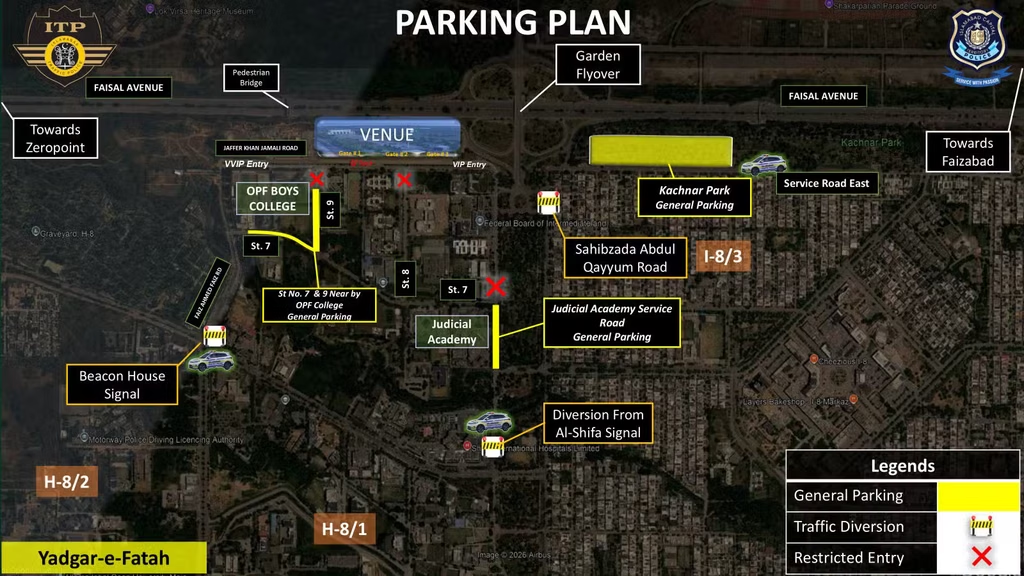
Islamabad Traffic Police (ITP) has issued a traffic plan for today’s ceremony at the Yadgar-e-Fatah monument in H-8. Two roads near the venue are closed and two diversions are in place. Drivers heading toward H-8, I-8 or the Al-Shifa Hospital area should expect delays and plan another route before leaving home.

Two Roads Are Closed Near the Monument

ITP has shut the following stretches for the duration of the event:

  • The service road from Al-Shifa Hospital toward the Federal Board
  • Faiz Ahmed Faiz Road, from Beaconhouse toward Jaffar Khan Jamali Road

ITP has not announced a specific reopening time. Drivers should assume both roads stay closed until the ceremony ends and the area clears.

Where Traffic Is Being Diverted

Vehicles coming from Sahibzada Abdul Qayyum Road are being sent toward the I-8 East Service Road. Traffic reaching Al-Shifa Signal is being turned toward Mir Chakar Road.

Expect slow movement at both diversion points. Traffic wardens will be directing vehicles manually, so signal timings near these junctions may not apply.

islamabad routes

The Three Routes ITP Recommends

ITP has advised citizens to use these roads instead:

  • Mir Chakar Road
  • Patras Bukhari Road
  • I-8 Main Double Road

Mir Chakar Road is also taking the diverted traffic from Al-Shifa Signal. That makes it the most likely of the three to back up. Drivers going toward I-8 may find the Main Double Road a faster option.

Park Only in Designated Areas

Police have asked people attending the ceremony to park in designated parking areas only. Do not leave your car on a service road or roadside near the closures. A parked car there blocks the diversion and puts you at risk of a challan.

Why H-8 Traffic Will Stay Busy After Today

The monument was inaugurated on 13 August 2026 by President Asif Ali Zardari and Prime Minister Shehbaz Sharif. It honours Pakistan’s martyrs and commemorates Marka-e-Haq.

According to Radio Pakistan, the monument opens to the public from Sunday. Visiting hours are 5:00 pm to 10:00 pm, every day except Monday. Entry is free, but visitors need a ticket from yadgarefatah.net.

The site also has a permanent 3D projection mapping system, with light shows planned for weekend nights. For drivers, this means more evening traffic around H-8 and I-8 from now on. Weekend evenings are likely to be the heaviest.

If you live or work in the area, consider leaving earlier on weekend evenings. Visitors should book tickets in advance and check parking arrangements before driving down.

Where to Get Live Updates

ITP shares live traffic updates on ITP Radio FM 92.4 and on its official social media pages. Check either before heading toward H-8 today.

New EDB Rules for Imported Used Cars

Imported car rules

On 30 September 2026, the Engineering Development Board (EDB) issued a notification that tightens the rules on commercially imported used vehicles. It took effect immediately. Vehicles in the relevant categories must now meet UNECE WP-29 safety and environmental regulations, or an equivalent standard the EDB accepts, and each one must pass inspection both before it ships and after it lands.

This is the most detailed quality control Pakistan has applied to the commercial import channel so far. It is also narrower than the headlines make it sound, and buyers should understand both points.

Background

The government opened commercial imports of used vehicles up to five years old in September 2025, subject to an additional 40% duty. The EDB adopted a first set of WP-29 standards at the same time and required pre-shipment and post-shipment inspection.

Implementation has been uneven. In April 2026 the EDB published a code of conduct for importers covering registration, tax status and after-sales obligations. In June, the Senate Standing Committee on Finance recommended withdrawing the EDB’s import notification, arguing it would hurt business activity and government revenue.

The 30 September notification shows the EDB has gone the other way and tightened the requirements rather than relaxing them.

What the Standards Cover

WP-29 is the UN framework that many car-producing countries use to harmonise vehicle regulations. The areas covered by the notification include:

  • brakes, steering and tyres
  • seat belts, airbags and child restraint systems
  • lighting
  • crash protection
  • emissions
  • safety requirements specific to electric vehicles

In practice, most recent Japanese-market cars are already built to these standards. The more important changes are about the condition of each individual car and the paperwork that goes with it.

Two Inspections for Every Car

Each commercially imported used vehicle now needs a pre-shipment inspection certificate. It must come from an internationally accredited agency registered with PSQCA under S.R.O. 2443(I)/2025. The certificate has to confirm that the car:

  • has no accident history
  • has an original odometer that has not been tampered with
  • has a sound engine
  • is within emission and noise limits
  • has no cracked glass
  • has its required airbags
  • has a verified manufacturing date
  • is roadworthy

Once the car arrives in Pakistan, a local representative of the same inspection company checks it again and confirms the original certificate is genuine and accurate. The importer pays for this second check.

That second step matters most. Paperwork from Japan has long been easier to fake than the car itself, and the post-arrival check is meant to close that gap.

Stricter Requirements for Importers

The notification also tightens who can import commercially. An eligible importer can be a company, a proprietorship or a partnership, and must hold a valid sales tax registration or NTN. Where relevant, vehicle imports must be the business’s main activity.

Importers must also pay through regular banking channels and keep full records of every vehicle they bring in. They need tie-ups with FBR-registered workshops for after-sales service. The aim is to push the trade toward documented, traceable businesses and away from informal operators.

Where the Rules Stop

The notification applies to commercial imports. It sets no new requirements for cars that are already registered and on the road in Pakistan.

This limitation is significant. Most imported cars available in Lahore right now arrived years ago, many through personal baggage, gift or transfer of residence schemes. That includes Vitz, Aqua, Prius, Mira and Move units. None of them will be re-examined under the new rules.

Old problems in the imported used car market are still around. Fake auction sheets, rolled-back odometers and resprayed accident repairs are common in the existing stock, and any car that has had a few owners locally may have been through repairs no certificate records.

Effect on Prices and Supply

Inspection and compliance add cost to every commercially imported car, and importers will pass it on. Weaker operators may leave the market, which could reduce the supply of newly imported units for a while.

For buyers, freshly imported cars should come with better documentation, at a higher price. That makes older imported cars already in the country look more attractive by comparison, which is exactly where the risk is highest.

Checks Buyers Should Still Do

For a newly imported car, ask for the pre-shipment certificate and the post-shipment verification. A legitimate importer will have both ready.

For any imported car that is already registered here, the new rules offer no protection. Check the auction sheet, compare the odometer against the recorded mileage, and have the body and engine inspected by someone who has no interest in the sale.

Verify Before You Pay

Car Mandi checks auction sheets for PKR 1,500 and confirms the export grade and mileage against the car itself. The private inspection costs PKR 4,000 and covers bodywork, engine and electrics at your location in Lahore. For an imported car registered before these rules came in, these two checks give you the protection the new notification does not.

All regulatory details are as of 1 October 2026.

Petrol at Rs387.40: What Seven Months of Fuel Inflation Means for Car Buyers

petrol price update

The Petroleum Division has set petrol at Rs387.40 per litre from 1 October 2026. That is 14 paisas lower than the previous day’s Rs387.54. High-speed diesel comes down by Rs1.89 to Rs400.35.

On its own, a 14-paisa revision has no effect on anyone’s running costs. The figure that matters is the March 2026 price of Rs321.17. Petrol has gone up by about Rs66 per litre since then, an increase of roughly 20% in seven months.

Anyone buying a car in Pakistan right now should be planning around that increase, not around the daily revisions.

How Pricing Works Under the New System

Pakistan revised fuel prices every fortnight until February 2026. After the US-Iran conflict started that month, the government moved to weekly revisions. In July the federal cabinet transferred pricing authority to OGRA and approved daily revisions.

OGRA now calculates petrol and diesel prices from a seven-working-day average of international Platts rates. New rates apply from midnight. Prices are held on Saturdays, Sundays and public holidays.

In practice, local pump prices now track global crude and the rupee within a week. That makes prices more transparent, and it also makes them more volatile. Owners should expect frequent small movements in both directions, with the overall level decided by the oil market.

The Cost of Fuel Economy Has Gone Up

Fuel efficiency has always mattered to Pakistani buyers. At current prices, the rupee difference between an efficient car and a thirsty one is large enough to affect the overall cost of ownership.

The figures below assume 1,500 km per month, which is a typical urban usage pattern.

City averageMonthly cost at Rs387.40Monthly cost at Rs321.17 (March 2026)
10 km/lPKR 58,110PKR 48,176
15 km/lPKR 38,740PKR 32,117
20 km/lPKR 29,055PKR 24,088
25 km/lPKR 23,244PKR 19,270

A car averaging 10 km/l now costs PKR 29,055 more per month to run than one averaging 20 km/l. Over a year that adds up to almost PKR 3.5 lakh. On a lot of mid-range used cars, that is more than a buyer would save by negotiating the price down.

These figures cover fuel only. Maintenance, tyres, insurance and token tax come on top.

Rated Mileage and Real Mileage Are Not the Same

Buyers usually compare fuel economy using the figures from the manufacturer or the seller. On a used car those figures often mean little. Real consumption depends on the car’s mechanical condition.

Low compression, dirty injectors, faulty oxygen sensors, worn spark plugs, sticking brake calipers and under-inflated tyres all increase fuel use. A short test drive will not reveal any of them. A car that should average 14 km/l in the city can easily return 10 or 11.

Imported hybrids need extra care. When an Aqua or Prius has a degraded hybrid battery, the petrol engine does much more of the work. Sellers will still quote the car’s original fuel average. At current fuel prices, a weak battery wipes out much of the reason for buying a hybrid.

Advice for Buyers

Look at purchase price and running cost together. Work out your actual monthly distance, then cost each car you are considering at the current OGRA rate and a realistic city average.

Have the car checked by someone other than the seller. The things that affect fuel economy are the ones that matter most: engine health, service history, and battery condition on hybrids. For imported cars, the auction sheet records the grade and odometer reading at export. If the current odometer does not match, walk away.

Advice for Sellers

Owners of cars in good condition should back that up with documents. An independent inspection report showing a healthy engine gives buyers a reason to pay your asking price, especially now that fuel costs are on every buyer’s mind.

Owners of larger-engine cars should expect running costs to come up in every negotiation. Pricing realistically at the outset will generally close the sale faster than waiting for a buyer who doesn’t care about fuel bills.

What to Watch

Now that pricing is daily, the domestic petrol price will follow international crude and the PKR/USD exchange rate with very little delay. Any developments in the Gulf will show up at the pump within days. So will any change to the petroleum levy, which requires Finance Division approval.

Anyone working out ownership costs should use the OGRA rate on the day they do the calculation, not a figure from last month.

Check the Car Before You Commit

A used car’s fuel economy depends on its condition, and condition has to be verified. Car Mandi’s private car inspection service costs PKR 4000 and covers the car’s mechanical health before you pay. For imported hybrids, auction sheet verification costs PKR 1,500 and confirms the export grade and original mileage.

All prices in this article are as of 1 October 2026.